
How to Authenticate a Loewe Flamenco Bag: 9 Checks

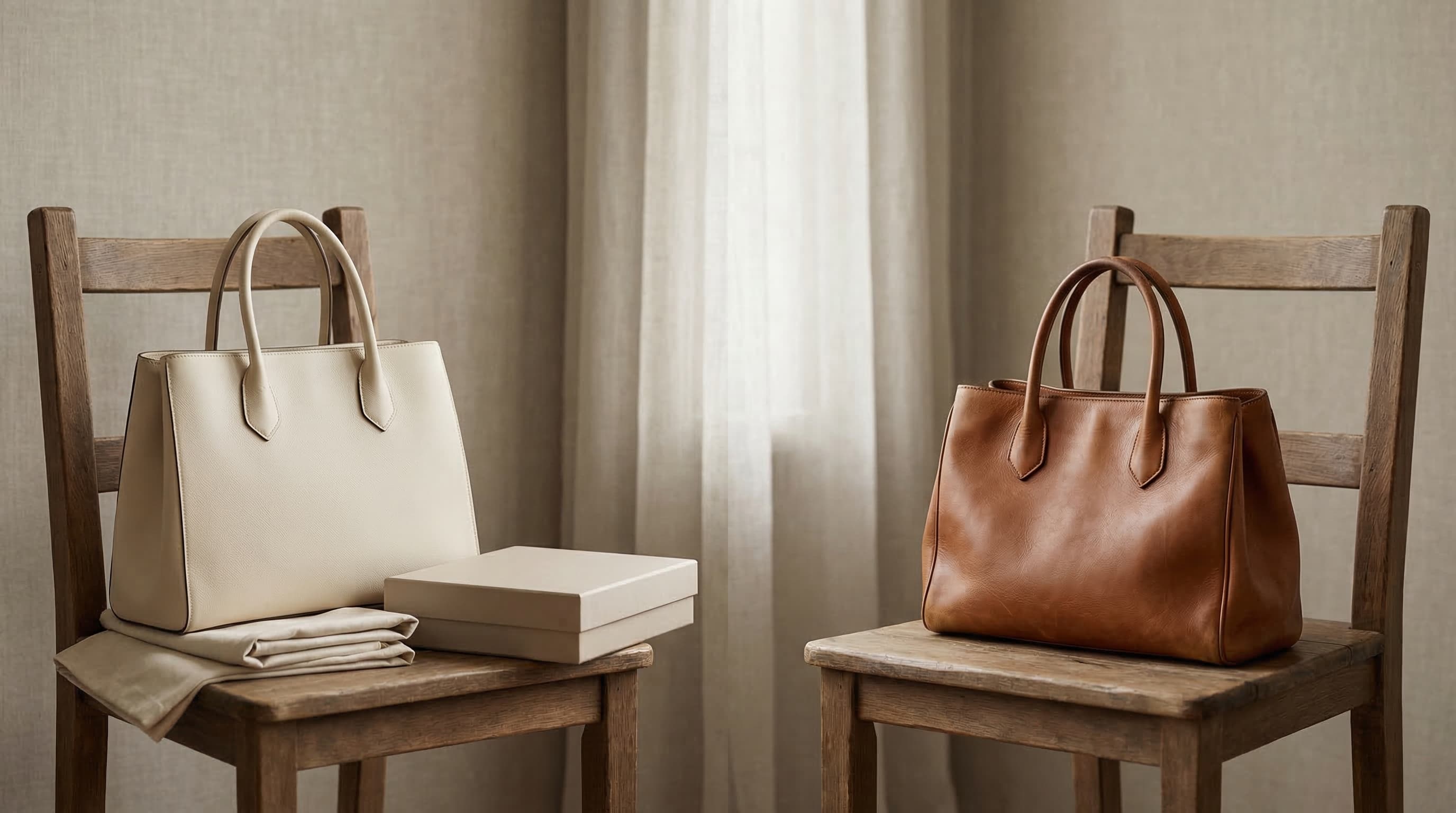
How to Authenticate a Loewe Flamenco Bag: 9 Checks (2026)
The Loewe Flamenco is a soft, slouchy drawstring bag defined by two things you can test with your hands: fluid nappa leather that cinches into gentle gathers, and the coiled knots that finish its drawstring pulls. Most current references date the original silhouette to 1984, with a revival under Stuart Vevers around 2010 and the modern clutch form reworked under Jonathan Anderson in the following decade; a few retailers loosely describe it as a 1970s or simply "1980s" design, so treat the decade wording as background rather than as an authentication test. What matters in the hand is agreement: the size class, the leather and lining, the way the knots are formed, the discreet magnetic closure, the Anagram or wordmark impression, the stitching, and the interior tag and origin mark should all belong to the same version of the bag. Copies often photograph the slouch convincingly, then separate on touch — leather that reads coated rather than supple, knots that are moulded blobs instead of coiled leather, a lining that feels papery, an Anagram pressed too deep or placed in the wrong corner, or an interior tag whose material and type do not match the bag around it. Work the nine checks in order and let them vote together. This guide sits in our wider authentication library: Balenciaga City, Balenciaga Hourglass, Balenciaga Le Cagole, Bottega Veneta Cassette, Bottega Veneta Jodie, Bottega Veneta Pouch, Cartier Love Bracelet, Celine Luggage, Celine Triomphe, Chanel 19, Chanel 2 55 Reissue, Chanel Boy Bag, Chanel Classic Flap, Chanel Coco Handle, Chanel Gabrielle, Chanel Wallet On Chain, Dior Bobby, Dior Book Tote, Dior Caro, Dior Lady Dior, Dior Saddle Bag, Fendi Baguette, Fendi Peekaboo, Givenchy Antigona, Goyard Saint Louis, Gucci Dionysus, Gucci Horsebit 1955, Gucci Jackie 1961, Gucci Marmont, Hermes Birkin, Hermes Bolide, Hermes Constance, Hermes Evelyne, Hermes Garden Party, Hermes Kelly, Hermes Lindy, Hermes Picotin Lock, Loewe Puzzle Bag, Louis Vuitton Alma, Louis Vuitton Capucines, Louis Vuitton Multi Pochette, Louis Vuitton Neverfull, Louis Vuitton Onthego, Louis Vuitton Pochette Metis, Louis Vuitton Speedy, Prada Cleo, Prada Galleria, Prada Re Edition 2005, Saint Laurent Kate, Saint Laurent Le 5 A 7, Saint Laurent Loulou, Saint Laurent Manhattan.
Quick note: no single check proves a bag is real. Weigh all nine together, and always against the exact size, leather and era the bag claims to be.
Short answer
A genuine modern Flamenco clutch is a soft Spanish-made drawstring bag in the size it is sold as — commonly the Nano (about 15 × 12.5 × 5.5 cm), Mini (about 24 × 18 × 9 cm), Medium (about 30 × 24.5 × 10.5 cm) or Large (about 38 × 32 × 13 cm) in current retail listings, with an XL and separate Flamenco Purse variants also in the family. Retailers do not all order or take these measurements the same way on a soft, gathered bag, and some guides list the Mini closer to 23 × 17 cm, so judge by size class and proportion rather than a single millimetre. The bag should cinch closed on drawstring pulls finished with coiled knots, fasten with a discreet magnetic closure, carry on a detachable and adjustable strap, and show a debossed Anagram at a top corner or an embossed LOEWE wordmark, depending on version. Inside, current clutch versions are suede-lined with one main compartment; older Knot versions may add an interior zip pocket. The leather should feel supple rather than printed, stitching should be tight and even, and the interior tag and origin mark should agree with the version claimed. Asking price is never a check.
1. Model, Era and Size Class
Start by naming what the bag claims to be, because "Flamenco" covers more than one generation. Editorial and retail sources most consistently date the original silhouette to 1984; Loewe's own retail copy at airport boutiques describes it more loosely as an iconic design launched in the 1980s, while some department-store copy calls the original a 1970s design. Those wordings do not agree with each other, so do not authenticate by origin slogan. Instead, fix the generation first: an earlier Knot or tassel-era bag, a Vevers-era revival bag, the Anderson-era Flamenco clutch with coiled knots and a magnetic closure, and the later Flamenco Purse with its donut chain are related, not interchangeable, references.
Then measure. Take base width, height and depth with the bag lightly filled and the drawstring relaxed, and compare the result to the nearest size class in the Short answer. A bag sold as a Mini that measures like a Medium, or a Medium whose height belongs to a smaller class, has a naming problem before it has an authenticity verdict. Because the body is soft, two honest sellers can differ by a centimetre or more depending on how full the bag is and whether height is read to the gathered top or the body; a difference of proportion — a bag that grows in width but not in height or depth — is more telling than a difference of a few millimetres.
Close with variant. Nappa calfskin, laminated or printed leathers, shearling and seasonal materials all change what Checks 3 and 4 should look for, and the Purse line does not share every dimension or strap detail with the clutch line. A grained or laminated bag judged by smooth-nappa standards, or a Purse judged against clutch measurements, is a category error.
2. Silhouette, Slouch and Strap
Set the bag down empty, then lightly filled. Empty, a genuine Flamenco should settle into a soft, gathered pouch rather than standing board-stiff or collapsing into a creased puddle; filled, the base should stay composed and the gathers at the top should fall evenly on both sides. The slouch is structural, not decorative — panels that buckle to one side, a base that twists, or gathers that only appear where the leather has been pre-creased by machine describe construction, not wear.
The carry options are part of the silhouette. Current clutch versions are designed to be carried by hand, on the shoulder or crossbody, with a detachable and adjustable strap; some versions add or substitute a chain or donut-chain strap. The strap should match the bag in leather, colour and hardware tone, with clean edges and even stitching, and its length should sit in the range listed for that version rather than at a generic substitute length. A strap that feels like a replacement accessory — different leather character, different edge finish, hardware in a tone the bag does not use — is a separate vote against, and at best a disclosure question the seller should answer plainly.
Read the outline last. The genuine profile is rounded and fluid with no hard internal frame showing through. Sharp internal edges, a rectangular shadow under soft leather, or sides that hold a crease exactly where a photograph was staged all suggest a shaped insert doing the work the leather should do.
3. Leather, Lining and Interior Plan
Name the material before you touch it. The standard modern clutch is nappa calfskin — soft, fine-grained and supple — and it should show natural, low-contrast variation that continues across panels rather than repeating like a print. Flex a discreet area gently: the surface should fold softly without crackling, whitening or splitting into a coated, plasticky shine, and colour should stay consistent between the outside of a panel and its folded edge. Nappa is delicate, so honest surface marks on a carried bag are condition, not verdict; a surface that feels sealed, rubbery or uniformly embossed is a materials problem.
Inside, current clutch versions are suede-lined, and the suede should feel dense and evenly napped rather than thin, papery or printed with a suede effect. Listings for the standard clutch describe one main compartment, while older Flamenco Knot versions are also listed with an interior zip pocket — so judge the interior plan against the named generation instead of demanding or forbidding a pocket across the whole family. The lining should sit smoothly without sagging, bunching or glue residue at the seams, and any pocket should be set straight with clean corner stitching.
Shearling and unlined seasonal versions exist in the family and are described as such by retailers, so an unlined interior is a failure only when the bag claims to be the standard suede-lined clutch. Smell and weight are supporting votes only: real nappa and suede smell like themselves, yet a pleasant hand never rescues failing knots, stitching or marks.
4. Drawstring and the Coiled Knots
The knots are the Flamenco's signature mechanism, so handle them as a test, not a glance. On the modern clutch, leather drawstring pulls gather the top and finish in coiled knots on either side — the gesture that gives the bag its skirt-like cinch. Each knot should read as leather actually coiled and formed: rounded, firm, continuous with the pull, and matched in character to its partner on the other side. Pull both drawstrings gently. The top should gather evenly, the knots should travel with the pulls rather than sitting as fixed decoration, and the leather should slide without grinding, squeaking or catching.
Copies lose this check predictably. Moulded or glued knot shapes with a visible seam, identical plastic-looking coils, knots that are soft and spongy with no internal structure, or pulls that gather one side while the other stays slack all describe imitation of the photograph rather than the mechanism. Earlier generations used tassel-style finishes instead of the modern coiled knot, so judge a genuinely older bag against its own era's finish — but within the modern clutch, a bag without working coiled-knot pulls is not the bag it claims to be.
Finish by relaxing the drawstring fully. The gathers should soften and the top opening should sit evenly; leather that keeps a machine-set crimp, or a top edge that springs into a perfect factory ruffle, has been shaped rather than made to move.
5. Stitching and Edge Finish
Loewe's leather-goods reputation rests on controlled hand-finishing, and resale authenticators specifically cite saddle-style stitching among the checks for the house's clutches. On a genuine Flamenco, stitching should run tight, even and consistent in tension, with regular spacing around the base, the strap attachments and any interior pocket, and matching runs on matching panels should agree with each other. Because the body is soft, most stitching is structural rather than decorative: look where panels join and where stress concentrates, not for a logo pattern in thread.
Copies tend to fail in one of two directions: runs that wander, skip or loosen at stress points, with thread sitting loosely on the surface; or runs so mechanically uniform across curves and joins that they read as printed regularity rather than guided work. Owners comparing genuine bags consistently describe the stitching as clean and precise, so a bag whose seams pucker the nappa, whose thread changes character between panels, or whose strap joins are stitched at a visibly lower standard than the body is telling you the parts were not finished to one standard.
Edges should agree with the stitching. Painted or folded edges should be smooth and continuous, without cracking, bubbling or colour that stops short at corners. A professionally repaired stitch on an otherwise correct bag is a condition disclosure, not a verdict; a stitch system that was never right is different.
6. Closure, Hardware and Any Zips
Do not look for the wrong mechanism. The modern Flamenco clutch closes with its drawstring cinch plus a discreet, hidden magnetic closure — there is no main zip to run on the standard clutch, and a bag sold as that version with a full top zip as its primary closure should be re-identified before it is judged. Work the magnet: it should meet its partner positively and hold the top closed in normal carry, without sliding, misalignment or a need to press the panels into position.
Hardware on the modern bag is deliberately quiet: strap fittings and any chain elements in a polished gold-tone or palladium finish matched to the version, finished evenly and consistent in tone across the bag. Metal should feel solid rather than hollow, plating should not show substitute-metal brightness at edges, and chain or donut-chain elements where fitted should articulate smoothly link by link. Mismatched hardware character on one bag — fittings in two tones without a design reason — describes assembled parts rather than one standard of making.
Where a zip genuinely belongs — the interior zip pocket listed on older Knot versions, for example — run it as you would on any bag: smooth travel on even teeth, a pull that matches the bag's hardware tone and feels solid, and clean stitching around the pocket opening. A grinding interior zip on a version that should have one is a located failure; a missing pocket on the standard suede-lined clutch, which listings describe with one main compartment, is not.
7. The Anagram and Wordmark Impressions
Loewe marks the Flamenco quietly, and the form of the mark depends on the version — which is exactly what to check. Current clutch listings describe a debossed Anagram at a top corner of the bag; other versions carry a gold- or silver-embossed LOEWE wordmark, and some listings describe an embossed logo or hot-stamped logo instead. None of these is interchangeable evidence: first establish which mark the claimed version carries, then judge that mark on its own terms.
A genuine impression, whether Anagram or wordmark, should be crisp and composed: clean letterforms or interlaced curves, even spacing, a depth that reads as part of the leather rather than printed on top of it, and placement that sits naturally in its corner or panel. Read it straight on and in raking light — a genuine impression holds up in both. Resale authenticators note that on raised-logo Loewe models the Anagram embossing must stay strict and aligned, so curves that drift, thicken unevenly or sit at a slight rotation against the panel are meaningful failures on a soft, otherwise undecorated bag where the mark carries the design.
Copies lose precision predictably: an impression that is shallow and blurred, or punched too deep and large; foil that flakes, sits proud of the surface or extends past the letterforms; or any misspelling of the wordmark. A tidy mark in the wrong place, in the wrong form for the version, or at the wrong scale is still a failed check — and a perfect mark never outvotes failing leather, knots and stitching by itself.
8. Interior Tag, Serial Marking and Origin
Open the bag and look for its internal records. Resale authenticators checking Loewe clutches cite three interior items together: an internal serial number, the heat-stamped "Loewe Made in Spain" mark, and the quality of the lining and stitching around them. Current retail listings for the Flamenco consistently give Spain as the country of manufacture, so an origin mark should agree with that; a clutch claiming current production with a different origin story needs an explanation grounded in the specific version, not a shrug.
Judge the tag and stamps as physical objects. The serial label should be made of material consistent with the bag, integrated and neatly finished rather than loosely attached, crooked or peeling, with clean, evenly set type. The heat stamp should be impressed with composed letterforms at a depth that reads as part of the material. A tag whose shape, material or typeface sits a grade below the bag, or a stamp that is blurred, off-centre or misspelled, joins the verdict rather than excusing itself.
Be honest about the limits. Loewe does not publish a public serial-number lookup, and no official chart in public sources decodes a Flamenco serial into a model, colour or date — so any seller or website claiming to "verify" the bag by typing its number into an official database is claiming something that does not publicly exist, and a number that merely looks plausible proves nothing, because copies carry numbers too. Use the interior records for agreement — tag, origin mark, lining and version telling the same story — never as a lone verdict or a dating shortcut.
9. The Full-Set Test: Documents, Dust Bag and Price Traps
Treat every extra as evidence about the seller, not about the bag. Loewe does not issue a plastic authenticity card whose number can be typed into a public lookup, so a card presented as proof proves nothing by itself. Dust bags, boxes, care booklets and receipts should match the era and version claimed; modern packaging paired with a supposedly older bag is a story problem, and packaging a grade below the bag is a warning — but correct packaging cannot rescue failing leather, knots, stitching, closures or marks.
Check the set against the version one last time. A standard clutch should arrive with the strap its version carries; a missing detachable strap, or a substituted chain on a version sold with a leather strap, is a completeness problem the price should reflect and the seller should disclose. Paperwork that names a different size, colour or material than the bag in hand describes a different bag, however genuine the paper is.
Finally, ignore price as a check. A high asking price does not authenticate, a low one does not condemn, and a receipt can describe a different bag. The verdict is the nine checks agreeing: right size class and generation, an honest slouch on a correct strap, supple nappa with the right lining and interior plan, working coiled-knot drawstrings, controlled stitching and edges, a discreet magnetic closure with consistent hardware, a correctly formed Anagram or wordmark, interior records that agree with Spanish manufacture, and extras that tell the same story.
At a glance: genuine vs copy
| Check | Genuine pattern | Common copy failure |
|---|---|---|
| Size class | Nearest of Nano / Mini / Medium / Large (or Purse/XL variant) with matching proportions | Dimensions belong to a different class or line |
| Silhouette | Soft gathered pouch, settled empty and filled | Board-stiff profile or shaped insert showing through |
| Leather & lining | Supple nappa calfskin; suede lining on standard clutch | Coated shine, printed grain, papery lining |
| Drawstring knots | Leather coiled knots that travel with the pulls and gather evenly | Moulded, glued or purely decorative knots |
| Stitching | Tight, even runs agreeing across panels | Wandering, loose or printed-regular runs |
| Closure & hardware | Hidden magnetic closure; consistent gold-tone or palladium fittings | Wrong main closure; mixed or hollow hardware |
| Anagram / wordmark | Correct form for the version, crisp and correctly placed | Blurred, over-deep, flaking or wrong-form mark |
| Interior records | Serial label and "Loewe Made in Spain" mark agreeing with version | Peeling tag, blurred stamp, origin mismatch |
| Extras | Era-consistent, same story as the bag | Card sold as proof; paperwork naming another bag |
FAQ
When was the Loewe Flamenco first released? Most current retail and editorial sources date the original silhouette to 1984, with a revival around 2010 and the modern clutch reworked in the following decade. Some retailers loosely say 1970s or simply 1980s, so the year is background context, not an authentication test.
What sizes does the Flamenco come in? Current clutch listings centre on the Nano, Mini, Medium and Large, with an XL and the separate Flamenco Purse line also in the family. Retailers measure soft, gathered bags differently and do not all order dimensions the same way, so compare by class and proportion rather than a single millimetre.
Does the Flamenco have a zip closure? The standard modern clutch closes with a drawstring cinch and a discreet magnetic closure, not a main zip. Some older Knot versions include an interior zip pocket; judge any zip against the version the bag claims to be.
Can I check a Flamenco's serial number online? No public Loewe lookup exists for this. A serial label is one internal record to weigh with the origin mark, lining, materials and construction — a plausible-looking number, or a card, proves nothing by itself.
Where is a genuine Flamenco made? Current retail listings for the Flamenco consistently state Made in Spain, and the interior heat stamp should agree with that. Treat an origin mismatch as a question the seller must answer with version-specific evidence.
Sources
- Luxbags — The Loewe Flamenco Bag Size Guide
- Liberty London — Loewe Flamenco Medium Leather Clutch Bag
- Liberty London — Loewe Flamenco Mini Leather Clutch Bag
- Liberty London — Loewe Flamenco Leather Clutch Bag details
- Selfridges — LOEWE Flamenco large leather clutch bag
- Selfridges — LOEWE Flamenco mini leather clutch bag
- Her World Singapore — Cheeky, curvaceous casual bag from Loewe
- PurseBlog — Introducing The Loewe Flamenco Purse
- Heathrow Boutique (Loewe retail copy) — Medium Flamenco clutch in nappa calfskin
- Farfetch — LOEWE Medium Flamenco Clutch in nappa calfskin
- Reversible (Loewe product details) — Mini Flamenco clutch in nappa calfskin
- Editorialist — Loewe Flamenco Clutch in Cream
- FWRD — Loewe Flamenco Clutch in Black
- JoliCloset — Pre-owned Loewe clutches, authenticated
- Neiman Marcus — Loewe Flamenco Clutch Bag in Moire-Print Leather