
How to Authenticate a Louis Vuitton Alma Bag: 9 Checks

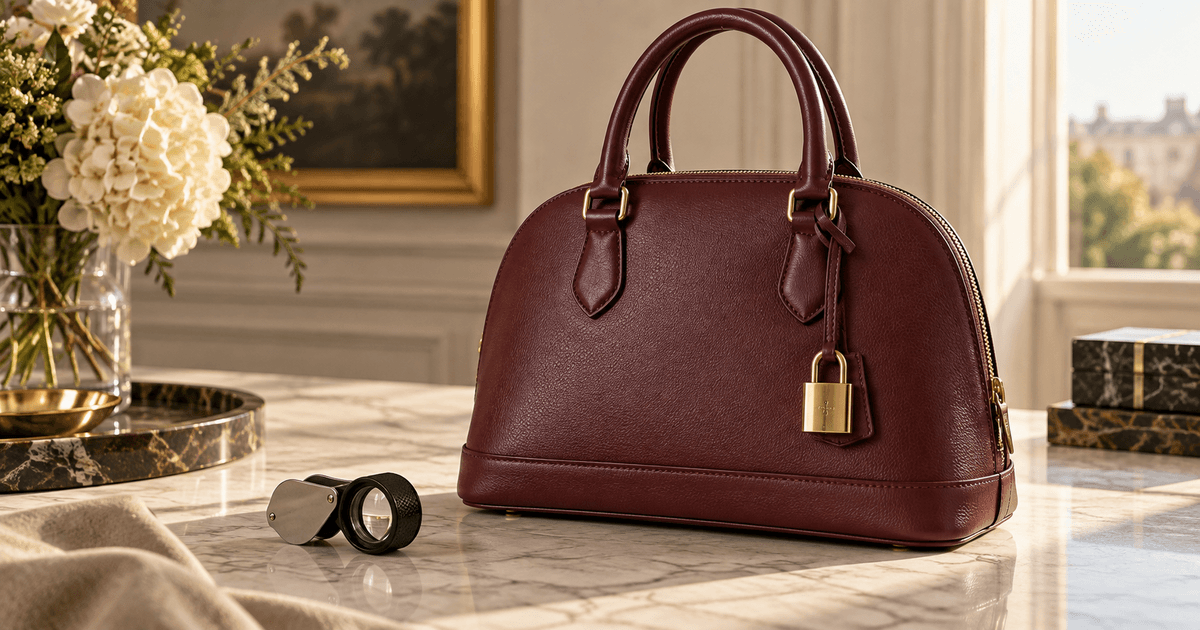
How to Authenticate a Louis Vuitton Alma Bag: 9 Checks (2026)
The Alma is the Louis Vuitton bag that stands up on its own. Where the Speedy slouches and the Neverfull folds, the Alma holds a strict domed silhouette on a flat structured base — twin rolled Toron handles, a wrap-around double zip, an engraved padlock with a leather key bell, and four protective metal studs underneath. Louis Vuitton describes the current Alma PM as recalling the Art Deco original introduced in 1934 and named after the Alma Bridge in Paris, with hand-stitched Toron handles, natural cowhide trim and gold-tone hardware. Secondary histories trace the same silhouette back through earlier names — Squire in 1934, Champs-Elysees in 1955, Alma from the early 1990s — and the naming timeline varies by source, so authenticators judge the bag in hand by construction, not by story. That structure is exactly what copies struggle to fake: a replica can print a monogram, but it rarely holds the dome, spaces the checkerboard correctly, puts five stitches where Louis Vuitton puts five, and ages its vachetta in one coherent honey tone. This guide runs the nine checks in the order authenticators use them. Louis Vuitton readers should read it beside our Louis Vuitton Speedy guide and Louis Vuitton Neverfull guide: the three icons share canvas, thread and date-code logic while differing completely in structure. Series context: How to Authenticate a Bottega Veneta Cassette Bag · How to Authenticate a Fendi Peekaboo Bag · How to Authenticate a Hermès Constance Bag · How to Authenticate a Dior Book Tote · How to Authenticate a Loewe Puzzle Bag · How to Authenticate a Gucci Jackie 1961 · How to Authenticate a Chanel Boy Bag · How to Authenticate a Saint Laurent Manhattan · How to Authenticate a Chanel 19 Bag · How to Authenticate a Dior Lady Dior Bag · How to Authenticate a Hermès Kelly Bag · How to Authenticate a Goyard Saint Louis Tote · How to Authenticate a Celine Triomphe Bag · How to Authenticate a Bottega Veneta Jodie · How to Authenticate a Balenciaga City Bag · How to Authenticate a Fendi Baguette Bag · How to Authenticate a Cartier Love Bracelet · How to Authenticate a Prada Galleria Bag · How to Authenticate a Saint Laurent Loulou · How to Authenticate a Gucci Marmont Bag · How to Authenticate a Dior Saddle Bag · How to Authenticate a Hermès Birkin · How to Authenticate a Chanel Classic Flap.
Quick note: no single check proves a bag is real. Authenticators weigh all nine together — and against the size, material, lining and production year the bag claims to be. A detail that is correct for a 2004 Monogram Alma PM can be wrong for a 2022 Epi Alma BB.
Short answer
An authentic Louis Vuitton Alma is a structured domed top-handle bag with a flat base on four protective metal bottom studs, twin Toron handles, a double-zip closure, an engraved padlock and a leather key bell. Louis Vuitton lists the core size ladder as Nano 18 × 12 × 8 cm, BB 23.5 × 17.5 × 11.5 cm, PM 32 × 25 × 16 cm and MM 36 × 28 × 17 cm, with the larger GM documented at about 39 × 30 × 19 cm in resale references. Materials span Monogram and Damier coated canvas, Epi leather, Monogram Vernis and Empreinte among others, trimmed in natural cowhide vachetta on canvas versions. Stitching is even, slightly angled, in mustard-yellow resin-coated thread, with exactly five stitches across the top of each handle tab on the modern Alma. Hardware is solid brass or gold-tone metal with real heft, the zip glides without gaps, and the heat stamp reads with a short-tailed L, very round O and near-touching Ts. Identity follows the house timeline: date codes inside the flat pocket on a leather tab until March 2021, then embedded microchips with no visible code. Fakes most often fail on a slouching dome, crowded or misaligned pattern, wrong stitch counts, bright thread, light toy-like padlocks and era-impossible codes.
1. Model, Silhouette, and Size — Name the Size Before You Measure
Start by confirming the bag in front of you is the size and version it claims to be, because "Alma" is a family:
- Fix the silhouette first. The Alma is a domed, structured top-handle bag: rounded top, straight sides tapering to a flat reinforced base, two rolled Toron handles, a double zip that wraps the top, and no exterior pocket on the classic versions. It should stand upright on its base studs without slouching. A soft, collapsing or bowling-bag-proportioned "Alma" fails the design before canvas is read — the shape discipline is the opposite of the soft duffel in our Louis Vuitton Speedy guide.
- Know the genuine size ladder before you measure. Louis Vuitton's own comparison lists Nano 18 × 12 × 8 cm, BB 23.5 × 17.5 × 11.5 cm, PM 32 × 25 × 16 cm and MM 36 × 28 × 17 cm; the discontinued GM is documented at about 39 × 30 × 19 cm. The BB adds a removable shoulder strap for cross-body carry; PM and MM are classically top-handle with strap sold separately. Replica lines routinely ship in-between dimensions that match no genuine size.
- Check the design set is complete and in proportion: double zip with two pulls, padlock, key bell in its leather clochette, four base studs, twin handles with pentagon-shaped handle attachments. A missing key bell on an honestly used bag is condition; a padlock in the wrong place or studs that are painted plastic is manufacture.
- Listings misname sizes constantly — "PM" is used for anything medium. Trust measurements over the title. Measure base length, height and depth yourself and match them against the claimed size and material.
2. Canvas and Pattern: Alignment Is the Branding
On a canvas Alma the pattern placement does the talking:
- Confirm the pattern family. Classic Almas are Monogram coated canvas (brown with LV initials and floral motifs) or Damier Ebene/Azur checkerboard; leather versions are Epi (fine horizontal grain), Monogram Vernis (glossy embossed patent) or Empreinte (embossed grained leather). Judge each by its own rules — Epi grain should be even and directional, Vernis embossing crisp under the gloss. A Monogram that feels like soft leather, or canvas that is shiny, plasticky or blurred under magnification, fails here.
- Read alignment across the body. On a genuine Alma the Monogram is symmetrical, centred and consistent with the bag's proportions, never cut off awkwardly at seams or hidden behind stitching; Damier squares are perfectly aligned with crisp edges, and the "Louis Vuitton Paris" square sits centred and correctly sized. Specialist real-vs-fake comparison of the Alma makes the replica direction explicit: fakes crowd smaller squares, misalign the checkerboard at seams, and use duller or overly dark tones where the genuine bag reads lighter brown-black.
- Check colour and texture in hand. Genuine Monogram canvas is firm, slightly grainy and matte with sharp print registration; Damier canvas has the same firm hand. Patchy colour between panels, a greenish cast, or print that smears at the motif edges is copy work.
- Follow the pattern around the base and zip. The genuine bag carries its alignment discipline around corners and under the zip line; a pattern that is tidy in the centre of the front but drifts, jumps or changes scale at the sides has failed where copies fail first.
3. Structure, Base, and the Four Studs
The Alma's structure is its signature — test it like one:
- Set the bag down empty on a flat surface. A genuine Alma stands upright and holds its dome, helped by a sturdy structured base. Pre-owned examples should retain that posture with honest softening at most; a new or lightly used Alma that slouches, creases strangely or flops to one side is a red flag authenticators state plainly.
- Turn it over. The base carries four protective metal bottom studs, evenly set, firmly seated and finished to match the hardware. They should feel like metal, sit at even heights so the bag does not rock, and show finish wear consistent with the rest of the hardware. Painted, hollow, uneven or missing studs — or a base that is soft and unstructured — contradict the model.
- Read the bottom leather and stitching. On vachetta-base versions the base leather should be substantial, evenly finished and stitched with thick, tight thread; the specialist Alma comparison notes replicas use thinner thread, looser stitches and inferior, differently toned bottom leather. Corner wear and light scuffs on a carried bag are condition; lifting, puckering or glue at the base seam is manufacture.
- Press the sides gently. The walls should feel firm and return to shape, neither board-stiff nor collapsing. That middle discipline — structure without cardboard — is hard to copy cheaply.
4. Handles and Attachments: Count to Five
The handle attachments are the Alma's fingerprint:
- Know the architecture. Two rolled Toron handles for hand or elbow carry, anchored by pentagon-shaped leather chapes (handle attachments) riveted to the body. On the BB, a removable strap adds shoulder or cross-body carry. Handles should be sturdy, symmetrical and evenly rolled, with stitching that creates a clean line along the edge.
- Count the stitches across the top of each handle tab: exactly five on the modern Alma, Neverfull and Speedy family — no more, no less, with no back-and-forth or zigzag reinforcement. Multiple authentication references state this count explicitly for the Alma and illustrate it on a 2004 example. A tab with four or six top stitches, or counts that differ between tabs, ends the conversation.
- Inspect the chapes under magnification. Genuine stitching around the pentagon pieces is tight, thick and even; replica stitching is sloppy, thin and uneven, the pentagon pieces differ in size, colour fades, and rivets look cheap — in documented comparisons the replica even misspells the rivet engraving. Rivets should be firmly seated, evenly finished and correctly lettered.
- Read the handles themselves. On vachetta versions they start pale and darken with handling (Check 6); on Epi and Vernis versions judge finish, even colour and clean edge stitching instead. Replica handles in the specialist comparison are duller, lighter, thicker and less refined, with uneven stitching oddly connecting both sides.
5. Stitching: Mustard-Yellow, Slightly Angled, Even Everywhere
Louis Vuitton stitching is a discipline check, and the Alma leaves it everywhere to see:
- On canvas versions the thread is mustard-yellow — resin-coated for durability and weather resistance, darkening only slightly with age like the vachetta it sits on. Bright lemon-yellow, orange or synthetic-looking thread is one of the fastest visual tells. On leather versions the thread matches and blends with the bag's colour, subtle rather than dramatic; mismatched thread colour is the replica direction in every Alma comparison.
- Stitches are even, dense and uniform: consistent length, spacing and count on matching sections, with a slight angle from hand-stitching. Perfectly straight machine-perfect rows, loose threads, skipped stitches, fraying or rows that wander at the chapes, zip and base are red flags.
- The same standard holds around the zipper and inside. Tight, clean stitching frames the double zip; replicas show uneven or loose threads exactly there. Count and compare: the stitch count on one handle chape should match its twin, just as in our Louis Vuitton Speedy guide.
- Thread should feel substantial, not thin. Thin thread that looks ready to come apart at a handle attachment is documented replica work, not a production variant.
6. Trim, Vachetta, and Patina — Read the Clock Correctly
On a Monogram or Damier Alma, the pale leather is a clock — but only on the versions that carry it:
- The handles, chapes, base and trim on canvas Almas are vachetta — untreated natural cowhide. Louis Vuitton notes the trim is natural cowhide finished through vegetal tanning that acquires a beautiful patina over time. New, it is pale creamy beige; with light, air and handling it darkens evenly through honey to deep caramel.
- Patina should be coherent across the bag. Handles darken fastest where hands grip; chapes and base follow. Deep honey handles with stark-white chapes — or a "carried daily for years" Alma with bright pale trim — suggest parts from different bags or artificial ageing. Water spots and gentle darkening are honest wear.
- Apply the right model's rules. Damier Ebene trim is chocolate-brown and does not patina like vachetta; Epi Almas are full leather with matching trim; Vernis is glossy patent. Judging an Ebene or Epi bag by "patina" is using the wrong checklist. Across all versions the leather should feel like leather — smooth, substantial, with cleanly finished edges and a leather scent, never stiff, plasticky or chemical.
- Bottom and handle leather should agree in tone and quality. The Alma comparison literature notes genuine bottom leather reads darker and higher quality while replica leather looks different and inferior — judge the set together, not piece by piece.
7. Hardware, Double Zip, Padlock, and Key Bell
Hardware is where light metal gives copies away:
- Genuine Alma hardware is solid brass or gold-tone metal with real heft — polished, durable, neither dull, lightweight nor toy-like. All pieces share one consistent tone and age together. The double zip should glide smoothly and evenly on both pulls; zippers that stick, catch, or show visible gaps between chain elements fail the check, as do shallow or misspelled engravings.
- The signature padlock is engraved, with crisp, well-spaced "Louis Vuitton" lettering in the house font. On the genuine padlock the letters read smaller and more spaced in the documented comparison; replica engraving is shallow, crowded, misspelled or in an artificial gold that looks toy-like. The padlock's back stamps follow era patterns (including "Made in France" on the oldest vintage) — a stamp claiming "Made in Paris" is a known fake tell, since made is followed by a country, not a city.
- The key bell (clochette) in matching leather houses the keys and carries them on the handle. Its leather, stitching and any hot stamp must agree in material, font and era with the rest of the bag; the specialist tag comparison notes genuine tags are matte with engraved, uncoloured letters and blending stitches, while replica tags use mismatched material, different fonts and visible stitching.
- Rivets, studs and zip pulls should be firmly seated and deeply, precisely engraved where the design engraves them — never printed, painted or hollow. A missing padlock or keys on an honestly used bag is condition to disclose; wrong-size, wrong-font hardware is forgery.
8. Heat Stamp and Fonts: Round O, Short L, Near-Touching Ts
Inside the bag, the stamp is the fingerprint counterfeiters get wrong most often:
- Find the interior leather stamp or label reading "LOUIS VUITTON / PARIS / made in [country]" — France, Spain, Italy or the USA on genuine production. It should be evenly pressed, crisp and aligned, with clean consistent stitching around it.
- Letterforms are the test. The "L" has a very short tail; the "O"s are big, very round (not oval) and look larger than the L; the two "T"s in "VUITTON" sit very close, almost touching but not quite; the font is thin, sharp and evenly spaced, with the ® symbol centred between the V and U. On genuine Alma signatures the letters are bold, clear and precisely spaced in the specialist comparison; replica fonts are thinner, smaller, faded, unevenly deep or washed out.
- Check relationships, not just letters. An obvious gap between the L and O, oval Os, distant Ts, a shifted ®, or a font that changes character mid-word is an instant red flag. Compare the interior stamp against the padlock and key bell lettering: they should agree as a set.
- Louis Vuitton does not issue plastic authenticity cards. Genuine bags come with small textile/paper tags with model and material information and a cotton dust bag whose lettering is thick and bold; thin, washed-out packaging fonts and plastic-wrapped hardware are documented replica traits.
9. Date Codes, Microchips, and the Interior
Until 2021 the Alma carried a production code; after that, a chip. Both must match the claimed year:
- Know where to look. On the Alma the date code is located inside the flat pocket, stamped on a leather tab — the location published in Yoogi's Closet's date-code guide and repeated across authentication references. Codes can fade or a lining replacement can remove them, so absence alone on a vintage bag is not proof, but the location and format must be right when present.
- Read the era correctly. The system runs: pre-1980 — no date codes; 1980s — three/four numbers (year/month) with factory letters added later in the decade; 1990–2006 — two letters (factory) plus four numbers read month/year (first and third digits month, second and fourth year); 2007 onward — week/year reading (first and third digits give the week, second and fourth the year); from March 2021 — no visible code at all, replaced by an embedded NFC microchip readable only against Louis Vuitton's internal database. Cross-check the factory letters against the "Made in" stamp: a French factory code with a "Made in Italy" stamp is impossible.
- Judge the interior as a set. Alma linings are cotton canvas or microfiber depending on version and era, with a flat pocket; on versions that use the rosy-red lining the genuine hue reads rosy-red and soft where replicas read dull pinkish-red with cheaper texture. Off-model linings, stiff shiny fabric or wrong pocket construction are major warnings. Interior stitching meets the same even standard as the exterior.
- Weigh the code correctly. Counterfeiters copy date codes, so a good-looking code only supports a bag whose canvas, structure, five-stitch tabs, hardware and stamps already pass — exactly the closing rule of our Louis Vuitton Neverfull guide. A crisp visible date code on a bag claimed to be from 2023, when Louis Vuitton had stopped stamping them, disqualifies the story. For a high-value purchase, use a professional authentication service and photograph, in order: front pattern alignment, both handle tabs top stitches, base and studs, zip and padlock front and back, key bell, interior stamp, lining and pocket, and the date-code tab or chip-era documentation.
At a glance: authentic vs. fake
| Check | Authentic | Common fake tell |
|---|---|---|
| Model & size | Structured dome, flat base, twin Toron handles, double zip; Nano 18×12×8, BB 23.5×17.5×11.5, PM 32×25×16, MM 36×28×17 cm (GM ~39×30×19) | Slouching or off-proportion body; in-between dimensions matching no size; missing studs/key bell as manufacture |
| Canvas & pattern | Firm matte canvas, sharp print; Monogram symmetrical/centred, Damier squares aligned and crisp | Crowded smaller squares, misaligned seams, dull/over-dark tones, blurred plasticky print |
| Structure & base | Stands upright empty; sturdy base with 4 even metal studs; thick tight base stitching | Collapsing dome; soft base, painted/hollow/uneven studs; thin loose base thread |
| Handles & tabs | Rolled Toron handles; pentagon chapes; exactly 5 stitches across each tab top; solid rivets | 4/6 or uneven tab stitches; sloppy thin chape stitching; faded pieces, cheap/misspelled rivets |
| Stitching | Mustard-yellow (canvas) or blending (leather), slightly angled, even and dense | Bright yellow/orange or mismatched thread; perfectly straight, loose, frayed or wandering rows |
| Trim & patina | Natural vachetta honeying evenly on canvas versions; correct trim per Damier/Epi/Vernis | Stark-white "aged" trim or incoherent tones; stiff plasticky chemical leather |
| Hardware & zip | Solid brass/gold-tone heft; smooth double zip; crisp padlock engraving; matte key bell | Light toy-like padlock, shallow/misspelled engraving; sticking zip with chain gaps |
| Stamp & fonts | Short-L, round-O, near-touching Ts, centred ®; bold clear stamp; no plastic authenticity card | Oval O, distant Ts, shifted ®; thin faded fonts; plastic cards/wrapped hardware |
| Code & interior | Pre-2021 code inside flat pocket matches factory/era; post-Mar 2021 chip, no visible code; correct lining | Era-impossible or factory-mismatched code; crisp code on claimed 2023 bag; wrong dull lining |
FAQ
When was the Louis Vuitton Alma introduced? Louis Vuitton describes the current Alma as recalling the Art Deco original introduced in 1934, named after the Alma Bridge in Paris. Secondary histories trace the silhouette through earlier names — Squire (1934), Champs-Elysees (1955) and Alma from the early 1990s — so the 1934 origin is consistent while the name timeline varies by source; authenticate by construction and size, not by the story alone.
What sizes does the Alma come in? By the house ladder: Nano 18 × 12 × 8 cm, BB 23.5 × 17.5 × 11.5 cm, PM 32 × 25 × 16 cm and MM 36 × 28 × 17 cm, with the discontinued GM documented at about 39 × 30 × 19 cm. The BB carries a removable cross-body strap; PM and MM are top-handle classics. Measure the bag — listings routinely mislabel sizes.
Where is the date code on an Alma, and what if there is none? Inside the flat pocket, stamped on a leather tab, on pre-2021 bags. From March 2021 Louis Vuitton replaced visible codes with an embedded NFC microchip, so a current Alma correctly has no code to find. On vintage bags a code can fade or be lost with a lining replacement — absence alone does not condemn a bag whose other eight checks pass, but a wrong-format or era-impossible code does.
How many stitches should an Alma handle tab have? Exactly five across the top of each handle attachment tab on the modern Alma — the count stated across authentication references and shared with the Neverfull and Speedy tabs. Count both sides: four, six, zigzag reinforcement or mismatched counts are replica work.
Does an Alma come with an authenticity card? No. Louis Vuitton does not issue plastic authenticity cards. A genuine Alma arrives with its padlock, keys in the leather key bell, small model/material tags and a cotton dust bag with bold, clear lettering. A plastic authenticity card or plastic-wrapped hardware points the other way.
Bottom line
Authenticating an Alma is a structure-first exercise: domed size ladder and standing posture first, then aligned canvas, a sturdy base on four metal studs, five-stitch Toron handle tabs, mustard slightly angled stitching, coherent vachetta, solid double-zip hardware with a crisply engraved padlock and key bell, a round-O heat stamp, and a pocket-tab date code — or a correctly codeless chip-era interior — that matches the claimed year. One failed check is a warning; two or more is a walk-away.
Related reading: How to Authenticate a Bottega Veneta Cassette Bag · How to Authenticate a Fendi Peekaboo Bag · How to Authenticate a Hermès Constance Bag · How to Authenticate a Dior Book Tote · How to Authenticate a Loewe Puzzle Bag · How to Authenticate a Gucci Jackie 1961 · How to Authenticate a Louis Vuitton Speedy · How to Authenticate a Chanel Boy Bag · How to Authenticate a Saint Laurent Manhattan · How to Authenticate a Chanel 19 Bag · How to Authenticate a Dior Lady Dior Bag · How to Authenticate a Hermès Kelly Bag · How to Authenticate a Goyard Saint Louis Tote · How to Authenticate a Celine Triomphe Bag · How to Authenticate a Bottega Veneta Jodie · How to Authenticate a Balenciaga City Bag · How to Authenticate a Fendi Baguette Bag · How to Authenticate a Cartier Love Bracelet · How to Authenticate a Prada Galleria Bag · How to Authenticate a Saint Laurent Loulou · How to Authenticate a Gucci Marmont Bag · How to Authenticate a Dior Saddle Bag · How to Authenticate a Hermès Birkin · How to Authenticate a Chanel Classic Flap · How to Authenticate a Louis Vuitton Neverfull
Sources
Facts in this guide were checked against the following public sources:
- Alma PM structured Art Deco original introduced in 1934, hand-stitched Toron handles, natural cowhide trim acquiring patina, gold-tone hardware, size comparison Nano 18 × 12 × 8 / BB 23.5 × 17.5 × 11.5 / PM 32 × 25 × 16 / MM 36 × 28 × 17 cm — Louis Vuitton, "Alma PM Monogram Canvas": https://en.louisvuitton.com/eng-nl/products/alma-pm-monogram-000511/M53151
- Earlier-name history Squire 1934 / Champs-Elysee 1955 / Alma 1992, full size list including GM 39 × 29 × 18.5 cm, material range Monogram/Damier/Epi/Vernis and exotics — Luxury Shops, "The Ultimate Guide: Louis Vuitton Alma Bag": https://luxury-shops.com/blog/the-ultimate-guide-louis-vuitton-alma-bag.html
- Size ladder Nano/BB/PM/MM/GM, one main compartment with two inside flat pockets, no outside pockets, double-zip closure, padlock/key bell/four protective metal bottom studs, strap arrangements by size, release date 1934 — Bragmybag, "Louis Vuitton Alma Bag": https://www.bragmybag.com/louis-vuitton-alma-bag/
- Front pattern lighter brown-black vs replica, grainier larger squares vs crowded, pentagon handle attachments with rivets, bold clear signature vs thin faded, zipper gaps, bottom leather and thick thread, matte uncoloured tag, rosy-red interior, handle finish, gold-like padlock with spaced letters, bold packaging fonts, final fake checklist — LegitGrails, "How To Spot Real Vs Fake Louis Vuitton Alma Bag": https://legitgrails.com/blogs/louis-vuitton/louis-vuitton-alma-fake-vs-real-guide
- Monogram symmetry and Damier alignment, vachetta honey patina, five-stitch handle attachments, solid brass hardware, date-code eras two letters plus four digits and post-2021 NFC chip, factory-vs-made-in cross-check, round-O/sharp-L font rules, Alma cotton canvas or microfiber lining, no authenticity cards — LegitGrails, "How To Spot Real Vs Fake Louis Vuitton Bag": https://legitgrails.com/blogs/louis-vuitton/real-vs-fake-louis-vuitton-bag-legit-check
- Exactly five stitches on top of each Alma handle tab (2004 example), mustard-yellow resin-coated thread darkening with age, slight stitch angle, short-L/round-O/near-touching-T stamp with centred ®, date codes until early 2021 then embedded NFC chips readable only by Louis Vuitton personnel, code never sole proof — CODOGIRL, "How to Tell a Real Louis Vuitton From a Fake": https://www.codogirl.com/blogs/news/louis-vuitton-authentication-guide/comments
- Alma date code inside flat pocket on leather tab; pre-1980 none, 1980s year/month formats, 1990–2006 month/year alternating digits, 2007 onward week/year; factory letters must match made-in stamp; code identifies manufacture not authenticity alone — Yoogi's Closet, "All About Louis Vuitton Date Codes": http://blog.yoogiscloset.com/louis-vuitton-date-codes/