
How to Authenticate a Chanel Coco Handle Bag: 9 Checks

How to Authenticate a Chanel Coco Handle Bag: 9 Checks (2026)
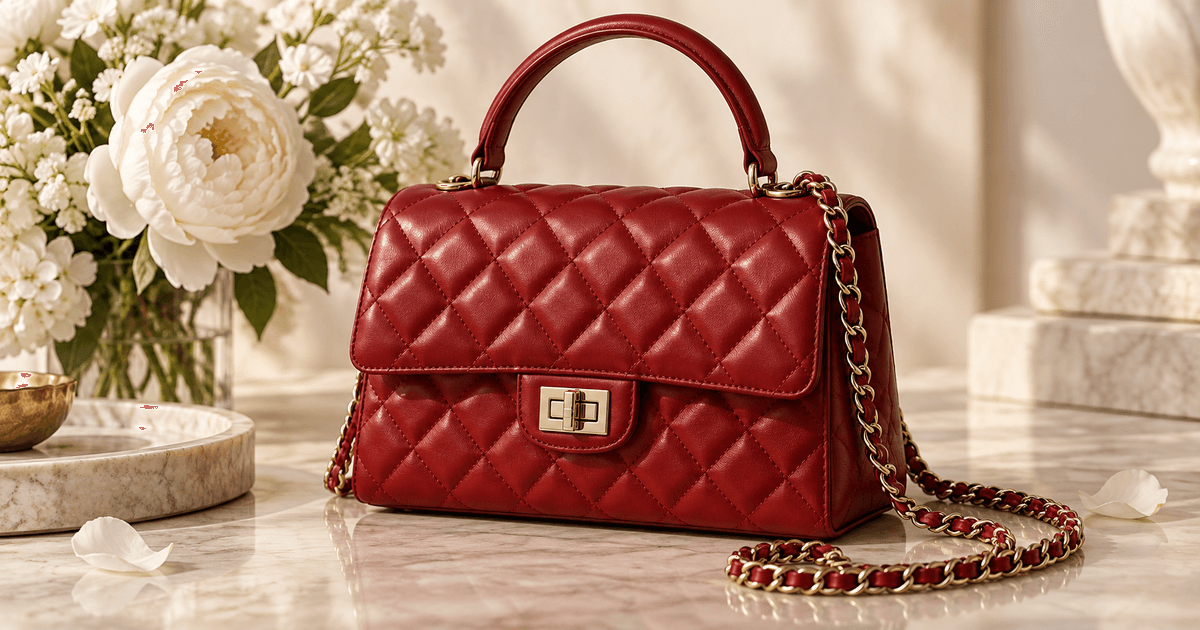
The Chanel Coco Handle is the house's top-handle answer to the Classic Flap: a trapezoid-shaped flap bag with a single structured top handle, an interlocking CC turnlock, a detachable interwoven leather chain strap and the Mona Lisa smile pocket across the back. First introduced in the Pre-Fall Winter 2015 collection and a permanent-collection staple within a few seasons — several references date its wider fame to 2017, when it moved from seasonal novelty to every-season fixture — the bag is named for Gabrielle "Coco" Chanel herself and is now cut most often in grained caviar calfskin, with calfskin, goatskin, chevron calfskin, lambskin and seasonal tweeds alongside. Early examples carried a lizard top handle, since replaced by calfskin or lizard-embossed calfskin. Copies copy the trapezoid quickly. They fail where this guide looks: the middle depth of that trapezoid, the size class and style code, the grain of the caviar and the symmetry of the diamonds, the front CC, the handle proportions and the engraved plates at its base, the screws behind the lock, the feet and leather patch on the base, the interior label, and the serial era a 2015-born model is allowed to carry. Chanel readers should start beside our Chanel Classic Flap guide, Chanel 19 Bag guide and Chanel Boy Bag guide: the four share quilting, chain and serial logic, while the Coco Handle adds the trapezoid body and top handle no flap-only model carries. Series context: How to Authenticate a Louis Vuitton Pochette Métis · How to Authenticate a Hermès Evelyne Bag · How to Authenticate a Prada Re-Edition 2005 Bag · How to Authenticate a Chanel Wallet on Chain · How to Authenticate a Louis Vuitton Alma Bag · How to Authenticate a Bottega Veneta Cassette Bag · How to Authenticate a Fendi Peekaboo Bag · How to Authenticate a Hermès Constance Bag · How to Authenticate a Dior Book Tote · How to Authenticate a Loewe Puzzle Bag · How to Authenticate a Gucci Jackie 1961 · How to Authenticate a Saint Laurent Manhattan · How to Authenticate a Dior Lady Dior Bag · How to Authenticate a Hermès Kelly Bag · How to Authenticate a Goyard Saint Louis Tote · How to Authenticate a Celine Triomphe Bag · How to Authenticate a Bottega Veneta Jodie · How to Authenticate a Balenciaga City Bag · How to Authenticate a Fendi Baguette Bag · How to Authenticate a Cartier Love Bracelet · How to Authenticate a Prada Galleria Bag · How to Authenticate a Saint Laurent Loulou · How to Authenticate a Gucci Marmont Bag · How to Authenticate a Louis Vuitton Speedy · How to Authenticate a Louis Vuitton Neverfull · How to Authenticate a Dior Saddle Bag · How to Authenticate a Hermès Birkin.
Quick note: no single check proves a bag is real. Authenticators weigh all nine together — and against the size, leather, hardware tone and production year in hand. A caviar Small, a chevron Large and a lambskin Mini share the trapezoid, the handle and the lock, but their surface checks differ. A detail that is right for one variant can be wrong for another.
Short answer
An authentic Chanel Coco Handle is a trapezoid flap bag with a single top handle, a front CC turnlock, a detachable leather-threaded chain strap and a rear Mona Lisa pocket, first shown for Pre-Fall Winter 2015 and now a permanent-collection style made most often in grained caviar calfskin. It is made in four current size classes — Mini about 13 × 19 × 9 cm, Small (listed as Medium in some references) about 14 × 24 × 10 cm, Large about 18 × 29 × 12 cm and Maxi about 22 × 33 × 12 cm — with style codes in the A92990 family (AS2215 for recent Minis). The body shows pronounced middle depth with full, rounded lower corners, the diamonds form a symmetrical grid that stays aligned with the flap closed, the front CC is round, wide and bright, the handle stands thin and tall over base plates engraved CHANEL in thick, closely set letters, and provenance is era-correct for a 2015-born model: eight-digit serial stickers until Chanel's 2021 switch to an embedded microchip plate, with no sticker or authenticity card after it. Fakes most often fail on a shallow trapezoid, oversized caviar grain, misaligned diamonds, a thick short handle, thin widely spaced base-plate lettering, screws crowded toward the lock's centre, and a seven-digit serial no Coco Handle may carry.
1. Model, Trapezoid and Size — Name the Bag First
Start by fixing which Coco Handle the bag claims to be, because the name now covers a decade of seasons, leathers and renamings:
- Place the model. The Coco Handle was first introduced in the Pre-Fall Winter 2015 collection; references that date it 2017 are dating its permanent-collection fame, not a different bag. The design set is fixed: trapezoid body wider at the base, front flap, single top handle, interlocking CC turnlock, detachable interwoven chain strap, rear Mona Lisa pocket, and inside one main compartment with two patch pockets and one zip pocket. A round or rectangular flap bag without the trapezoid and handle is not this model at any season.
- Know the size before you measure. Current production runs in four classes (height × width × depth): Mini 13 × 19 × 9 cm, Small 14 × 24 × 10 cm, Large 18 × 29 × 12 cm, Maxi 22.1 × 33 × 11.9 cm. Naming drifts between retailers — the 14 × 24 × 10 cm bag appears as both Small and Medium — and a discontinued XXL at 24.9 × 33 × 10.9 cm (the original Maxi before the Large was renamed upward) circulates secondhand. Judge the measurements in hand, not the size word in the listing. Style codes cluster in the A9299x family — A92990 for the Small/Medium, A92991 Large, A92992 Maxi, with AS2215 on recent Minis — and a code outside the family for the claimed size needs an explanation. Handle drop runs about 7 cm on the Mini and 7.6 cm on the Small and Large; the removable chain drops about 46 cm on the Mini and 51 cm on the larger sizes.
- Read the trapezoid from the side. A genuine body has deeper, pronounced middle depth — the profile swells visibly between front and back — with fuller, rounded lower corners. The specialist comparisons are consistent: replicas run shallower through the middle, the flap section reads small, and the bottom corners turn sharp and acute. A flat-sided trapezoid fails before any logo is read.
- Trust construction over the listing title. Sellers apply "Coco Handle" to Trendy CC flaps, Classic Flaps with aftermarket handles and unrelated trapezoid totes — the size, pocket set and handle in hand outrank the label, exactly as with the Chanel Wallet on Chain, where the claimed variant must match the bag before any other check is read.
2. Leather and Diamond Quilting: Grain, Grid and Thread
On the body itself, material and stitch pattern are the first evidence — and the hardest for copies to hold at scale:
- Read the caviar first. Most Coco Handles are grained calfskin (caviar): fine, even pebbling with a matte, supple hand. The side-by-side guides converge — replica grain runs bigger, coarser and visibly patterned, reading cheap and plasticky beside the genuine pebble. Smooth lambskin and chevron calfskin versions replace the pebble read with sheen and chevron alignment, but the same rule holds: genuine surfaces are fine and even, copies are coarse or irregular. Note the handle leather separately — early lizard handles are genuinely exotic and now discontinued; current handles are calfskin or lizard-embossed calfskin, and an "original lizard" claim on a recent-season bag is an era error.
- Read the diamond grid. Genuine quilting forms a symmetrical diamond grid, each square aligned with the row above, and the grid stays aligned across the flap when the bag is closed. Replica quilting drifts: spacing varies, diamonds misalign at the flap edge, and the puff reads wrong — too flat or too swollen where genuine quilts sit full but controlled. Natural softening on a carried vintage piece is wear; a new-claimed bag with flat or ballooned diamonds is manufacture.
- Read the thread. Genuine stitching is thick, solid thread worked at even tension through body, flap and handle. Replica thread runs thinner, loosens early and changes weight between panels. Compare the handle stitching against the body stitching on the same bag — a handle sewn to a different standard than its body is a parts set.
- Weigh wear honestly. Caviar softens and quilts relax with years of carry; that is use, not a verdict. What fails is manufacture: coarse grain, a wandering grid and thin thread on a bag presented as recent production.
3. The Front CC Turnlock: Round, Wide and Bright
The interlocking CC on the flap is the model's signature — and, read closely, one of its most reliable checkpoints:
- Read the form. On a genuine lock the Double C is rounder and wider, with rounded edges and a flawless cast; the two Cs overlap in the house proportion with the right C over the left at the top. Counterfeit Cs run asymmetrical and distorted, edges sharp where they should be rounded, one C visibly heavier than its pair.
- Read the finish. Genuine hardware — gold-tone or silver-tone by season — is shiny and reflects light strongly, the surface smooth and consistent. Replica locks read dull beside it, the plating thinner, sometimes stuck between silver and gold on the handle attachments of the same bag. Mixed tones between the front lock, the handle plates and the chain on one bag mean mixed production — a fail, here as on the Chanel Boy Bag.
- Work the lock. The turnlock should rotate and seat in one smooth, firm motion with no grinding or play. The stem and press studs of a genuine lock hold their finish through use; plated replicas peel and fade at exactly these touch points.
- Photograph it straight-on. The CC is centred on the flap and level; a lock sitting high, low or a degree rotated is visible in any honest listing photo — ask for that photo before discussing any other detail.
4. The Handle and Its Base Plates: Thin, Tall, Thick-Lettered
The single top handle gives the model its name — and its proportions are a checkpoint copies consistently miss:
- Read the handle's proportions. A genuine handle appears thinner and taller, with a sleek, elongated arc that stands clear of the flap. The replica handle is notably thicker and shorter, squatting over the body in the wrong proportion. Judge it against the size class from check 1: a Mini handle on Large hardware, or the reverse, is a variant mismatch.
- Read the plates at the handle's base. Each attachment sits on a circular metal plate engraved CHANEL. On a genuine plate the text is thicker, with the letters closely placed; the engraving is well-defined and holds under magnification. On copies the same word runs thinner and paler, the letters narrower and spaced too far apart, the plate itself flatter and wider with an indistinct logo.
- Read the metal tone as a set. Genuine plates carry the season's tone fully — the rose-gold tint noted on genuine hardware reads warm and even. Replica attachments sit between silver and gold, the tone changing between the two plates of one handle. One plate warm and one pale is not patina; it is two productions.
- Work the handle. It is stiff by design and should feel planted at both plates with no wobble or lift. A handle that rocks at its base, or plates that sit proud of the leather with gaps, fail the construction read.
5. Behind the Lock: The Back Plate, Its Screws and Its Lettering
Open the flap: the reverse of the closure carries a second, quieter set of engravings that superfakes reproduce worst:
- Find the plate. On the interior side of the closure are the inscriptions CHANEL and PARIS, with two screws — one to the left, one to the right. That layout, complete, is the model. A missing inscription, a single screw or screws stacked vertically contradicts it.
- Read the lettering depth. On genuine metal the text is engraved less deeply, so the letters read thinner and narrower. Counterfeit engraving is cut too deeply, so the same letters run thick and bold — the error is counterintuitive, and it is consistent across the specialist guides: deeper is worse here. The same depth rule governs the zipper of check 8.
- Read the screws. Genuine screws are smooth and round, seated with adequate distance from the buckle's centre, and the plate around them is clean. Replica screws sit uneven, crowded too closely toward the centre, sometimes with a strange outline ring around each screw head. A screw that rocks, burrs or sits in a halo fails.
- Judge it with check 3. The front CC, the back-plate lettering and the handle-plate lettering are one hardware programme: thin-shallow behind the lock, thick-compact on the handle plates, round and bright on the flap. A bag whose three readings disagree with each other has been assembled, not made.
6. The Base: Feet, Leather Patch and Standing Shape
Turn the bag over. The base is photographed least in listings — and finished worst on copies:
- Read the feet. Genuine base studs are vibrant, round and wide, the gold full-toned and evenly finished. Replica feet run thicker in profile yet smaller across, and more reflective — a harder, mirror-like shine on a smaller button. Feet that differ from each other in tone or width on one base fail the set.
- Read the leather patch. A rectangle of leather is stitched to the bottom of the bag. On genuine production its measurements are restrained and consistent for the size class; on replicas the same patch is much bigger, covering visibly more of the base. Measure it against the base width from check 1 — a patch scaled wrong for its size class is a tooling tell no photograph angle hides.
- Read the standing shape. Empty and closed, a genuine Coco Handle stands on its base with the trapezoid intact, lower corners full, middle depth present from the side. A base that bellies, corners that collapse inward or a body that slumps off its feet contradict the structured construction — wear softens a carried bag gradually and evenly; it does not sharpen its corners.
- Ask for the base photo. Sellers photograph what flatters; authenticators ask for what copies fail. The base, the back plate of check 5 and the handle plates of check 4 are the three requests that sort a listing fastest.
7. Interior Label and Back Pocket: Fine Stitching, Calm Corners
Inside and behind, the finishing standard either holds across the whole bag or it does not:
- Read the interior label's stitching. Around the genuine leather label the stitching is thin, long and spaced, framing the stamp evenly. Replica stitching runs thick and short, appearing boxy, crowding a label that itself sits asymmetrical in the lining.
- Read the stamp. CHANEL on a genuine label is thin and wide with proper spacing between the letters; MADE IN below it is consistently thick and readable, and the ® symbol is proportional and centred. On copies CHANEL turns thick, narrow and cramped, MADE IN ITALY shrinks thin and small, and the ® sits misaligned and too thick. The stamp should be embossed into the leather, not printed on its surface — and Chanel never stamps "Made in Paris": that line, anywhere, ends the assessment. The grey-versus-white lettering contrast noted on some versions follows the same rule — sharp and even is genuine, uneven and washed is not.
- Read the interior as a layout. One main compartment, two patch pockets, one zip pocket, with lining fitted flat. Some seasons line the bag in leather, others in fabric — the lining material follows the variant and season, so judge fit and finishing rather than expecting one fixed colour. Loose, bubbling lining, raw edges or a missing zip pocket contradict the model.
- Read the back pocket. The Mona Lisa pocket across the back closes the bag's design set. Its corners are subtly curved, with less pronounced arching on genuine production; replica pocket corners are overly curved, arching more than they should, the pocket's quilting drifting out of alignment with the body's grid from check 2. A back pocket that is the wrong shape on a bag with the right front is still the wrong bag.
8. Zipper, Chain and Keychain CC: One Engraving Standard
The remaining hardware repeats the rules of checks 3–5 at smaller scale — which is exactly why copies fail it:
- Read the zipper. The zipper pull carries CHANEL engraved with the same shallow discipline as the back plate: thinner letters from shallower engraving are genuine; thick letters cut too deeply are the replica tell. The pull should run the interior zip pocket smoothly end to end with no binding, and its tone must match the front lock and handle plates exactly.
- Read the chain. The detachable strap is an interwoven leather chain — metal links threaded with leather matching the body — with the drops noted in check 1 (about 46 cm Mini, 51 cm larger sizes). Genuine links are even, the leather threading full and tight, the clasps engraved to the same standard as the zipper. Stretched links, thin threading that gaps, or clasp lettering at a different depth than the zipper's mean a substituted strap.
- Read the keychain CC. Where the model carries the small CC charm, the genuine logo is thinner, boxier and smaller; the copy runs too thick, wide and large, its Cs swollen out of proportion. Small hardware is not exempt hardware — Chanel finishes a charm to the same cast standard as the front lock.
- Work every closure once. Turnlock, interior zip, handle plates and chain clasps should all operate with the same firm, finished feel. One gritty, loose or peeling component among smooth ones is the component that was not made with the bag.
9. Serial, Authenticity Card and Dust Bag: The 2015 Timeline
End with provenance — read against the only timeline this model is allowed to have:
- Place the model on Chanel's timeline first. Chanel used seven-digit serial stickers in the early era, eight-digit stickers from the 10-series onward, then replaced the sticker and authenticity card with an embedded microchip metal plate from 2021. The Coco Handle was born in 2015 — deep inside the eight-digit era. A Coco Handle carrying a seven-digit serial is therefore a wrong-era fake on its face, before any other check is read.
- Read the sticker era (2015–2021). Eight digits, beginning in the 20-series and running into the 31-series by the switch, printed on the sticker inside the bag and matched by the same number on the authenticity card. The card itself is a checkpoint: sturdy as a credit card, its serial printed in perfect alignment, its gold border thick and almost glittery — thin, pale gold with a logo too faint to read is the copy. Cards for bags made after 2005 carry a grey circle in the top right corner; that circle is correct here, because every genuine Coco Handle is post-2005. A missing card alone proves nothing — cards are lost and swapped — but a mismatched number between sticker and card is decisive.
- Read the chip era (from 2021). Later bags carry no visible sticker and no card by design; provenance sits on the metal microchip plate inside. A claimed 2022 or later Coco Handle presented with a printed serial sticker is the fake tell running in reverse, exactly as on the Chanel 19 Bag and Chanel Boy Bag. A correct-era absence is not a gap.
- Read the dust bag plainly. Chanel bags produced from 2000 onward ship with a black dust bag (white belongs to the 1980s–90s), so every genuine Coco Handle pairs with black. Packaging supports; it never rescues. One soft signal — a lost card, honest corner wear — is a note. A seven-digit serial, a sticker on a claimed chip-era bag, or the shallow trapezoid of check 1 is a walk-away.
At a glance: authentic vs. fake
| Check | Authentic | Common fake tell |
|---|---|---|
| Model & size | Trapezoid flap with top handle, CC turnlock, detachable chain, Mona Lisa back pocket; Mini 13 × 19 × 9 cm / Small 14 × 24 × 10 cm / Large 18 × 29 × 12 cm / Maxi 22.1 × 33 × 11.9 cm; A9299x codes (AS2215 recent Mini); deep middle profile, full rounded lower corners | Shallow middle depth; small flap section; sharp acute bottom corners; wrong size class or code family for the claimed variant |
| Leather & quilting | Fine even caviar pebble, matte supple hand; symmetrical diamond grid aligned with flap closed; thick solid thread at even tension | Bigger coarser grain, cheap plasticky read; misaligned or uneven diamonds; quilts too flat or too swollen; thin thread loosening early |
| Front CC turnlock | Rounder, wider CC with rounded edges and flawless cast; bright finish reflecting light; smooth firm turn; centred and level on flap | Asymmetrical distorted CC with sharp edges; dull finish or tone stuck between silver and gold; peeling stem and studs; lock off-centre |
| Handle & base plates | Handle thinner and taller with elongated arc (drop about 7–7.6 cm); base plates engraved CHANEL in thick closely placed letters, warm even tone | Handle thicker and shorter, squatting over body; plate text thin, pale, narrow and widely spaced; plates flat, wide, indistinct or mismatched in tone |
| Back plate & screws | CHANEL & PARIS inside flap; shallow engraving so letters read thin and narrow; screws smooth, round, set away from centre, no outline ring | Deep engraving with thick bold letters; screws uneven or crowded toward centre; strange outline around screw heads |
| Base | Feet vibrant, round and wide; bottom leather rectangle restrained and size-correct; bag stands with trapezoid intact | Feet smaller, thicker, mirror-reflective; leather patch much bigger; base bellies or corners collapse |
| Interior label & pocket | Label stitching thin, long, spaced; CHANEL thin and wide, MADE IN thick and readable, ® proportional and centred; 1 main + 2 patch + 1 zip pockets; back-pocket corners subtly curved | Stitching thick, short, boxy; CHANEL thick, narrow, cramped; MADE IN thin and small; ® misaligned; pocket corners overly curved and arched; quilting misaligned |
| Zipper, chain, charm | Zipper CHANEL thin from shallow engraving; interwoven leather chain even with full threading (drop about 46–51 cm); charm CC thinner, boxier, smaller; all hardware one tone | Zipper letters thick from deep engraving; chain links stretched, threading gapping; charm CC too thick, wide, large; tones mixed between pieces |
| Serial & packaging | 2015-born model: eight-digit sticker + matching card to 2021, microchip plate and no sticker/card from 2021; card sturdy, gold border thick, grey circle top right; black dust bag | Seven-digit serial (wrong era); printed sticker on claimed post-2021 bag; mismatched sticker/card numbers; flimsy card with thin pale border; white dust bag |
FAQ
When was the Chanel Coco Handle introduced? For the Pre-Fall Winter 2015 collection. Some references date the bag 2017 because that is when it settled into the permanent collection and became an every-season fixture; the 2015 and 2017 dates describe the same model's launch and its rise, not two different bags. Early examples carried a lizard top handle, since replaced by calfskin or lizard-embossed calfskin.
What sizes does the Coco Handle come in, and what are the style codes? Four current classes: Mini about 13 × 19 × 9 cm, Small about 14 × 24 × 10 cm (listed as Medium in some references), Large about 18 × 29 × 12 cm and Maxi about 22.1 × 33 × 11.9 cm, plus a discontinued XXL at 24.9 × 33 × 10.9 cm. Codes sit in the A9299x family — A92990 Small/Medium, A92991 Large, A92992 Maxi — with AS2215 on recent Minis. Retailers mix the Small and Medium names, so judge the centimetres, not the size word.
What is the most reliable single check on a Coco Handle? The trapezoid read together with the handle plates. A genuine body keeps pronounced middle depth with full, rounded lower corners, the handle stands thin and tall, and the circular plates at its base are engraved CHANEL in thick, closely placed letters. Replicas flatten the profile, thicken and shorten the handle, and space the plate lettering thin and far apart. No single check is a verdict — cross-read it against the quilting grid, the back-plate screws and the serial era.
My Coco Handle has no serial sticker. Is it fake? Not on that evidence. Bags made from 2021 carry an embedded microchip metal plate instead of a sticker and authenticity card, so a post-2021 bag with no sticker is correct — while a printed sticker on a claimed post-2021 bag is a fake tell. For a 2015–2021 bag the eight-digit sticker should be present and match its card; because the model was born in 2015, a seven-digit serial is wrong for any Coco Handle.
Can wear make a real Coco Handle look fake? Yes, in the places copies are also weak, which is why wear must be dated, not just noted. Quilts relax, caviar softens, handle plates and lock stems lose finish at touch points, and the base feet polish bright. Even, gradual wear consistent with the bag's claimed age is use. Sharp bottom corners, a shallow profile, thin widely spaced plate lettering and deep-cut zipper engraving are manufacture — they were wrong the day the copy was made.
Bottom line
Authenticating a Coco Handle is a proportion exercise wrapped in house discipline: fix the trapezoid and its size class first — deep through the middle, full at the corners, A9299x under the flap — then read caviar that stays fine under a diamond grid that stays aligned, a front CC cast round and bright, a handle standing thin and tall over plates lettered thick and close, screws sitting smooth and wide behind a shallow-engraved back plate, feet and a base patch scaled to the bag, an interior label stitched thin and stamped calm, and provenance that respects a 2015 birth: eight digits and a matching card to 2021, a chip and no sticker after it. One failed check is a warning; a shallow trapezoid, thin-spaced handle plates or a seven-digit serial is a walk-away.
Related reading: How to Authenticate a Louis Vuitton Pochette Métis · How to Authenticate a Hermès Evelyne Bag · How to Authenticate a Prada Re-Edition 2005 Bag · How to Authenticate a Chanel Wallet on Chain · How to Authenticate a Louis Vuitton Alma Bag · How to Authenticate a Bottega Veneta Cassette Bag · How to Authenticate a Fendi Peekaboo Bag · How to Authenticate a Hermès Constance Bag · How to Authenticate a Dior Book Tote · How to Authenticate a Loewe Puzzle Bag · How to Authenticate a Gucci Jackie 1961 · How to Authenticate a Saint Laurent Manhattan · How to Authenticate a Dior Lady Dior Bag · How to Authenticate a Hermès Kelly Bag · How to Authenticate a Goyard Saint Louis Tote · How to Authenticate a Celine Triomphe Bag · How to Authenticate a Bottega Veneta Jodie · How to Authenticate a Balenciaga City Bag · How to Authenticate a Fendi Baguette Bag · How to Authenticate a Cartier Love Bracelet · How to Authenticate a Prada Galleria Bag · How to Authenticate a Saint Laurent Loulou · How to Authenticate a Gucci Marmont Bag · How to Authenticate a Louis Vuitton Speedy · How to Authenticate a Louis Vuitton Neverfull · How to Authenticate a Dior Saddle Bag · How to Authenticate a Hermès Birkin · How to Authenticate a Chanel Classic Flap · How to Authenticate a Chanel 19 Bag · How to Authenticate a Chanel Boy Bag
Sources
Facts in this guide were checked against the following public sources:
- Trapezoid form with deep middle depth and small flap on replicas, caviar grain larger on fakes, CC rounder and wider with shiny finish, handle thinner and taller on genuine bags, handle-base plates with thicker closely placed CHANEL versus thin widely spaced, back-plate CHANEL & PARIS with shallow thin lettering and screws away from centre, base feet vibrant round and wide with restrained leather patch, interior label stitching and letterforms, back-pocket corners subtly curved, zipper CHANEL thin from shallow engraving, charm CC thinner boxier smaller — LegitCheck, "Chanel Guide: REAL vs FAKE Coco Handle Bag (2026)": https://legitcheck.app/guides/chanel/real-vs-fake-chanel-coco-handle/
- Overall trapezoid and flap proportions, calfskin grain and symmetrical quilting with thick solid thread, CC lock rounder and flawless, handle-attachment plates with defined engraving and rose-gold tint, bottom feet and patch sizing, closure screws smooth and round without outline, interior label asymmetry and lettering as fake tells, authenticity-card gold border thick and glittery — LegitGrails, "How To Spot Real Vs Fake Chanel Coco Handle Bag": https://legitgrails.com/blogs/chanel/real-vs-fake-chanel-coco-handle-bag-legit-check
- Size table in inches (Mini 5.1 × 7.5 × 3.5, Small 5.5 × 9.4 × 3.9, Medium 7.1 × 11.4 × 4.7, Large 8.7 × 13 × 4.7), caviar grain bigger on replicas, diamond alignment and flat-or-swollen quilts as tells, handle thinner and taller, base-plate lettering thick and close versus thin and far, CC thinner boxier smaller on the keychain, zipper and buckle engraving depth rules, pocket-corner arching, interior-label letterforms, serial timeline (7-digit 0–9 series, 8-digit from 10-series) and authenticity-card grey circle after 2005, black dust bag from 2000 — Extrabux, "Chanel Coco Handle Bag Real vs. Fake Guide 2025": https://www.extrabux.com/en/guide/8257015
- First introduced in the Pre-Fall Winter 2015 collection, permanent-collection status, trapezoid shape with front flap, CC closure, single handle and woven chain strap, sizes Mini 13 × 19 × 9 cm / Medium 14 × 24 × 10 cm / Large 18 × 29 × 12 cm / Maxi 22.1 × 33 × 11.9 cm / XXL 24.9 × 33 × 10.9 cm with XXL discontinued and Large renamed Maxi, style codes AS2215 / A92990 / A92991 / A92992 / A92993, interior 1 main + 2 patch + 1 zip pockets and 1 exterior back pocket, handle drops 7–10.2 cm and removable strap drops 46–51 cm, materials caviar, calfskin, goatskin, snakeskin, metallic caviar, chevron calfskin and the discontinued lizard handle — Bragmybag, "Chanel Coco Handle Bag Review, Price List": https://www.bragmybag.com/chanel-coco-handle-bag/comment-page-12/
- Permanent trapezoid style with interlocking CC closure offered each season since its debut (dated 2017 in this reference, read here as the permanent-collection era following the 2015 launch) and the four-size Extra Mini / Mini / Small / Medium naming used by resale — FASHIONPHILE Academy, "A First-Time Investor's Guide to Chanel": https://blog.fashionphile.com/investors-guide-to-chanel/