
How to Authenticate a Hermès Evelyne Bag: 9 Checks

How to Authenticate a Hermès Evelyne Bag: 9 Checks (2026)
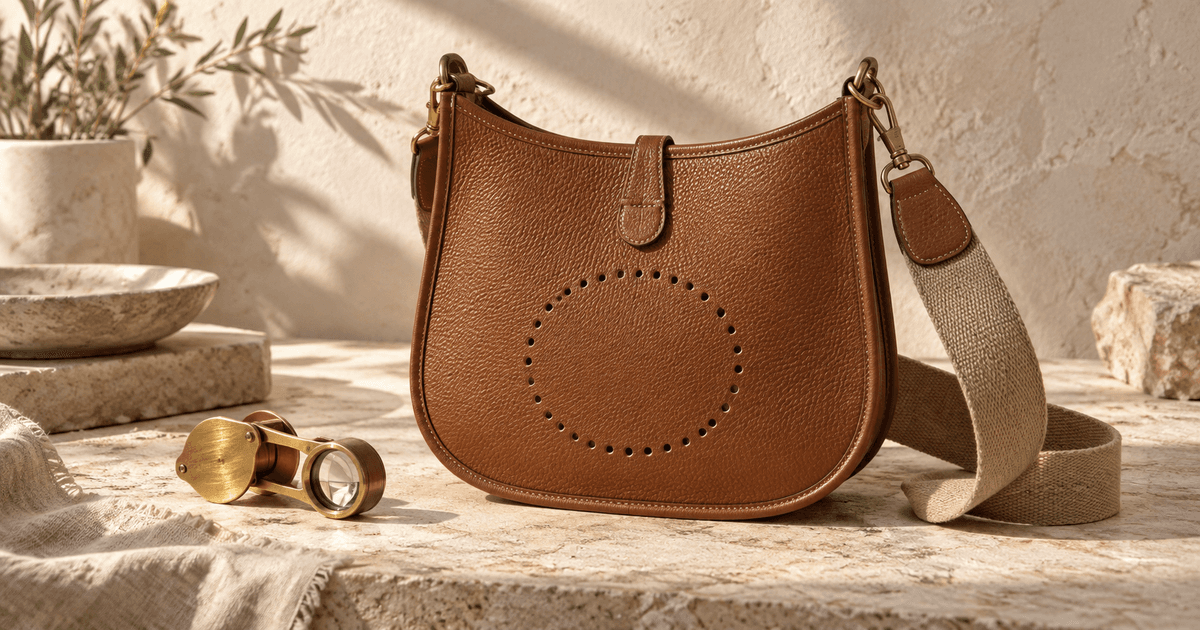
The Hermès Evelyne began as equipment, not ornament. Created in 1978 by Evelyne Bertrand, head of the Hermès riding department, it was a carryall for horse groomers' brushes and sponges — sewn without a lining, closed with a leather tab, and pierced on one side with a perforated H so damp tools could dry. Hermès' own story for the current Evelyne III 29 says the same: since 1978 the bag was first intended to tend horses, is sewn without a lining, and carries an H perforation that initiates wear against the body so the equipment can dry. That working bag is now a daily crossbody — and a heavily copied one. The copies get the outline quickly: a soft rectangle, a canvas strap, a dotted H. They fail where this guide looks: the generation and size claimed, the exact 63 perforations and their oval, the leather and its raw suede reverse, the hand saddle stitching, the woven strap and its clasps, the snap, the foil heat stamp, and the blind stamp read by era. Hermès readers should start beside our Hermès Constance guide and Hermès Kelly guide: the three share the house rules on heat stamps, blind stamps and saddle stitching, while the Evelyne adds the perforation count no other Hermès bag has. Series context: How to Authenticate a Prada Re-Edition 2005 Bag · How to Authenticate a Chanel Wallet on Chain · How to Authenticate a Louis Vuitton Alma Bag · How to Authenticate a Bottega Veneta Cassette Bag · How to Authenticate a Fendi Peekaboo Bag · How to Authenticate a Hermès Constance Bag · How to Authenticate a Dior Book Tote · How to Authenticate a Loewe Puzzle Bag · How to Authenticate a Gucci Jackie 1961 · How to Authenticate a Saint Laurent Manhattan · How to Authenticate a Dior Lady Dior Bag · How to Authenticate a Hermès Kelly Bag · How to Authenticate a Goyard Saint Louis Tote · How to Authenticate a Celine Triomphe Bag · How to Authenticate a Bottega Veneta Jodie · How to Authenticate a Balenciaga City Bag · How to Authenticate a Fendi Baguette Bag · How to Authenticate a Cartier Love Bracelet · How to Authenticate a Prada Galleria Bag · How to Authenticate a Saint Laurent Loulou · How to Authenticate a Gucci Marmont Bag · How to Authenticate a Louis Vuitton Speedy · How to Authenticate a Louis Vuitton Neverfull · How to Authenticate a Dior Saddle Bag · How to Authenticate a Hermès Birkin · How to Authenticate a Chanel Classic Flap · How to Authenticate a Chanel 19 Bag · How to Authenticate a Chanel Boy Bag.
Quick note: no single check proves a bag is real. Authenticators weigh all nine together — and against the generation in hand. An Evelyne I has no exterior pocket and a fixed strap; an Evelyne II moved the pocket outside and kept the fixed strap; an Evelyne III keeps the exterior pocket and adds an adjustable strap; the separate Evelyne Sellier is a structured version with an embossed diamond H in place of perforations. A detail that is right for one generation can be wrong for another.
Short answer
An authentic Hermès Evelyne is an unlined leather crossbody first designed in 1978, made in sizes named by width — TPM 16, PM 29, GM 33 and TGM 40 cm, with a later 23 size also in the line — carrying a perforated H of exactly 63 holes (40 around the oval, 9 down each arm of the H, and 5 across its middle) with raw, unfinished, evenly spaced perforation edges. The body is Clemence, Epsom, Maurice, Hunter or another Hermès leather over its own raw suede back, with no separate lining, sewn with clean hand saddle stitching that slants naturally, bound edges, a durable web canvas strap with leather accents matching the body, era-correct snap and clasp hardware in one plating throughout, a crisp HERMÈS / PARIS / MADE IN FRANCE heat stamp whose foil matches the hardware, and a blind stamp whose year letter is read together with its shape — no shape, circle or square — according to its era. Fakes most often fail on the perforation count, size and spacing, a lined or glued interior, perfectly straight machine stitching, mixed hardware plating, a thin or oversized heat stamp font, and a blind stamp whose shape and letter do not agree.
1. Generation, Model and Size — Name the Version First
Start by fixing which Evelyne the bag claims to be, because the line has changed in ways copies routinely mix up:
- Place the generation. The original 1978 Evelyne (Evelyne I) carried a fixed-length removable strap and an interior pocket, with no exterior pocket. The Evelyne II, reissued around 2000, removed the interior pocket in favour of an exterior back pocket and kept the non-adjustable strap. The current Evelyne III retains the exterior pocket and adds an adjustable canvas strap. The Evelyne Sellier, introduced around 2016, is the structured outlier: rigid leather, usually Epsom, an embossed H in a diamond outline instead of perforations, and no rear pocket. A bag sold as an Evelyne III with a fixed strap, or as a Sellier with punched holes and a back pocket, mixes generations — judge it as a mismatch, not a detail.
- Know the sizes before you measure. The four classic sizes are named by width: TPM (Très Petit Modèle) 16 cm, PM (Petit Modèle) 29 cm, GM (Grand Modèle) 33 cm and TGM (Très Grand Modèle) 40 cm; a 23 cm size also appears in the current line. The PM 29 is the most carried daily size. Measure a soft bag laid flat and empty: Clemence slouches, so height and depth readings move by centimetre with how the bag is measured — authenticated Evelyne III 29 examples cluster around 29 cm wide, roughly 28–30 cm high and about 8–10 cm deep. A TPM sold at PM money, or a 29 that measures like a 33, fails on identity before materials are read.
- Check the design set is complete for the generation: perforated H panel, leather tab closure with snap, web canvas strap, era-correct pocket placement, and bound edges all round. On a Sellier, expect the embossed diamond H and a structured body instead. A missing strap on resale is an inclusions question (it detaches); a missing exterior pocket on a claimed III, or an adjustable buckle on a claimed I, belongs to a different generation.
- Trust the pocket, the strap and the measurements over the listing title. Sellers use I, II and III interchangeably, and "Sellier" is often applied to any stiff Evelyne — the construction in hand outranks the label.
2. The Perforated H: Count 63, Then Read the Oval
The punched H is the Evelyne's signature and its most countable check:
- Count the holes. The genuine perforation is made of exactly 63 holes: 40 forming the surrounding oval, 9 down each vertical arm of the H (18 in total), and 5 across the middle bar. A count of anything else — a short oval, eight-hole arms, a four-hole bar — is not a Hermès perforation, however tidy it looks at arm's length.
- Read the oval. The outline around the H forms an oval that is neither too pointed nor too circular at its sides. A pinched, egg-shaped or perfectly round surround distorts the letterform the holes are meant to draw; step back and check the H reads evenly, with the arms parallel and the middle bar centred.
- Read the holes themselves. Genuine perforations have raw, unfinished edges and are evenly spaced and evenly sized. On the Petit Modèle the hole diameter is given by The RealReal's specialists as 4.25 mm, with hole size varying by bag size across the line. Counterfeits commonly punch bigger, misaligned or uneven holes, so the vertical arms and the horizontal bar disagree in size and the H leans. Ragged tearing, melted-looking rims or holes that wander off their lines fail here.
- Remember the direction story, but do not authenticate by it. The perforations were ventilation for grooming tools and, in Hermès' telling, the H panel initiates wear against the body; today it is usually worn facing out. Either wearing direction is seen on genuine bags — the count, oval and edges are the evidence, not which way the last owner carried it.
3. Leather and the Unlined Interior: One Skin, Read Both Sides
The Evelyne is a single-skin bag, and both faces of that skin have a correct read:
- Name the leather. Most Evelynes are Taurillon Clemence — a heavy, matte, flat-grained calfskin that softens and slouches — or Epsom, a lightweight embossed-grain calfskin that holds a cleaner outline. Maurice and Hunter also appear, and older or rarer versions exist in leathers such as Box and Sombrero. Grain should be even and natural for its type: Clemence that stands board-stiff, Epsom with a printed-looking repeat, or any leather with a plastic sheen or chemical smell points away from Hermès.
- Turn the bag inside out in your mind. Hermès sews the Evelyne without a lining; the interior is the raw, sueded back of the same leather, in the bag's own colour family. A sewn-in fabric lining, a glued synthetic interior, or a bright finished inner face contradicts the model — copies add linings to hide construction, which is exactly what this bag does not have. This is the same interior discipline as our Hermès Constance guide, where what is under the flap separates factory work from copies.
- Read the edges. Genuine Evelyne edges are bound along all sides, raw yet even, with reinforced stitching at stress points and on the leather parts of the strap. Painted-over lumpy edges, glue residue at the binding, or corners finished in different manners on the same bag are copy work.
- Judge wear honestly. Clemence relaxes, corners rub and the suede back marks with use — that is a carried bag, not a condemned one. What fails is manufacture: peeling surface finish, crackling grain on a claimed-new bag, or a body whose two sides are visibly different leathers.
4. Saddle Stitching: Slant by Hand, Never by Ruler
Hermès hand-sews its leather goods, and on an unlined bag every stitch is visible from both sides:
- Follow the seams. The house uses a hand saddle stitch with a natural slant — clean and even, but not mechanically perfect. The RealReal's valuation manager puts it directly: the style is always done by hand, may not always be straight or perfect, yet must always be clean, with no obviously misplaced stitching and no glue residue. A run of perfectly ruler-straight, identically spaced machine stitching is the counterfeit signature, not the goal.
- Check both faces. Saddle stitching locks two threads through each hole, so front and back should read as the same careful work. One tidy face hiding a loose, wandering reverse is not saddle construction.
- Check the reinforcements. Edge casing, strap leather components and closure areas carry reinforced stitching that finishes cleanly, with backstitching at ends so nothing frays. Skipped stitches, doubled messy corrections, loose tails or stitching that changes character halfway along a seam fail.
- Weigh it with the leather. Stitching sits in the holes the awl made; stretched, torn or oversized stitch holes around the perforation panel and strap attachments show thread pulled through inferior material. On this model the sewing has nowhere to hide — exactly as on the Hermès Kelly, where stitch discipline carries much of the verdict.
5. The Canvas Strap: Webbing, Leather Accents and Adjustment
The strap is half the bag's silhouette — and its generation marker:
- Read the material set. The removable strap is extremely durable web canvas with leather accents that match the bag's exterior leather. Canvas should be dense and even, neither shiny nor fraying at the edges when new; leather tabs should match the body in leather type, colour and stitch quality. A thin printed strap or accents in a different leather story are parts-bin tells.
- Read the adjustment against the generation. Only the Evelyne III (and the later line) has the adjustable strap; Evelyne I and II straps are fixed. A claimed I or II with an adjustment buckle, or a claimed III without one, contradicts check 1. Decorative strap variants exist in the line — striped, Rocabar and other Hermès strap designs — so judge an unusual strap pattern as a strap question, and authenticate the bag body on its own checks.
- Work the hardware ends. Strap clasps should close positively and sit straight, with finished edges and weight. Current clasps carry a small HERMÈS inscription in all caps on one side of the clip; vintage clasps may be more curvilinear and plainer. Flimsy spring gates, sharp casting burrs or a clasp that twists in its housing fail.
- Find the strap stamp where it belongs. The metallic HERMÈS / PARIS / MADE IN FRANCE stamp appears on the leather accent of the web strap on genuine examples, matching check 7. A strap with no stamp on a version that should carry one is a question to weigh with the bag stamp — straps are swapped and replaced, so a wrong strap weakens the set without automatically condemning the body.
6. Hardware and the Snap: One Plating, Era-Correct Marks
Evelyne hardware is minimal, which leaves each piece exposed:
- Fix the plating set. Current bags use palladium-plated hardware; vintage 1990s bags may carry gold-plated hardware. Either can be correct — what cannot is a mixture: the house rule repeated by specialists is that all hardware on the bag shares one plating, and a bag mixing gold and palladium pieces is a counterfeit or a repaired parts set that must be disclosed and judged as such.
- Read the clasp engraving. On strap clasps the HERMÈS inscription should be deep, clean and polished, with sharp letter edges and smooth groove interiors. Shallow laser-style engraving that looks white or grey inside the letters, or lettering that sits on the surface like a scratch, is replica work.
- Read the snap by era, not by one pattern. The leather tab closure's snap changed over production: older bags may have a blank snap, others show four letters in a compass-rose pattern on the female component, and current bags may read SBH in one section; the male component stays attached to the bag and may be flat or carry radiating lines at its edge. Two negative rules are firm: a genuine Evelyne snap should never carry a brand name or six stars — both mark counterfeits.
- Work every closure. The tab should pull through and snap shut with a positive, centred action, and the two D-rings should be smoothly finished with no dents, peeling or plating bubbles. Hardware that flakes, rings that are visibly cast and unpolished, or a snap that needs force and luck to seat fails the set — the same hardware discipline as in our Cartier Love Bracelet guide.
7. The Heat Stamp: Foil, Font and Placement
The visible brand stamp is small, foil-pressed and easy to copy badly:
- Read the words. The stamp reads HERMÈS / PARIS / MADE IN FRANCE in three lines. It is found on the bag beneath the pull-through closure strap, and on the leather accent of the web strap; larger sizes may carry an additional stamp on the shoulder strap. Missing MADE IN FRANCE, misspelt words, or a fourth decorative line fail before font is judged.
- Match the foil to the hardware. The stamp is metallic debossing whose colour matches the hardware plating — silver-tone with palladium, gold-tone with gold. A gold-foil stamp beside palladium hardware breaks the set in one glance.
- Read the font. Genuine type is bold, substantial and perfectly aligned, pressed with a rich metallic lustre where foil is used. Counterfeit stamps run noticeably thinner, oversized, or faded with dull foil, letters unevenly sized or bleeding at the edges. The È keeps its grave accent; a plain E in HERMÈS is a wrong typeface, not a variant.
- Allow the leather its say, no more. On grained Clemence a stamp sits less glassy than on smooth Epsom — texture softens any impression. What texture never does is change the letterforms, spacing or line order. Judge type first, depth second, exactly as in our Hermès Birkin guide.
8. The Blind Stamp: Letter, Shape and Era Together
The blind stamp is the Evelyne's date record — and the check most often misread by using the letter alone:
- Find it where the era puts it. Markings sit on the underside or inside of the leather closure strap, including, on newer Evelyne III bags, inside the leather tab near the shoulder-strap attachment; period references also place the craftsman and date markings together there. It is pressed without ink, beside craftsman characters. A printed, inked or stickered "code" is not a blind stamp.
- Read the shape before the letter. The system runs in eras: 1945–1970 a single letter with no shape; 1971–1996 the letter inside a circle; 1997–2014 the letter inside a square; from 2015 no shape again, with the first letter of a longer stamp giving the year and the following letters and numbers identifying the craftsman side — a directory only Hermès holds. So a square-framed R reads as 2014 and a square-framed O as 2011, while the same letters unframed would read decades apart. A worn circle misread as a square moves the answer by roughly a generation — if the frame is unclear, the honest verdict is unclear.
- Judge the strike. Each character is struck individually and reads deep, clear and crisp on a genuine bag. Shallow, faint or uniformly perfect machine-flat characters — including stamps made deliberately light so they resist reading — are replica habits.
- Weigh it correctly. The blind stamp dates the bag; it does not, alone, authenticate it. Copies copy stamps, craftsman characters have no public key, and a correct-era stamp on a bag that fails perforations, leather and stitching rescues nothing. Its power is in agreement: era, shape, placement and strike all matching the generation established in check 1.
9. Dust Bag, Box and the Whole-Set Rule
Finish with what comes around the bag — useful support, never a verdict:
- Read the dust bag by era. Current Hermès dust bags are herringbone toile with chocolate-brown text and cord; before them came orange cotton, and earlier still tan flocked versions. Black, green or grey dust-bag text, or the wrong cord colour, is wrong for the current era — and a correct current dust bag beside a claimed 1990s bag is an era question, not a comfort.
- Read the box plainly. The orange box has stayed broadly consistent, so it supports a set without dating it. Sellers pair genuine packaging with fake bags often enough that packaging upgrades nothing: a correct box never rescues a 61-hole H.
- Photograph in authentication order. For a high-value purchase, capture: the perforated panel straight-on for the count, size measurements laid flat, both leather faces and the unlined interior, strap front and clasp engraving, snap both components, heat stamp in raking light, and the blind stamp with its shape visible — then have a professional authentication service read the set, ideally with the bag in hand.
- Weigh the whole. One soft measurement on a slouchy Clemence PM is a note; a wrong perforation count, a lined interior or a mixed-plating hardware set is a walk-away. The Evelyne gives buyers an unusual gift — a logo you can count. Count it, then let the other eight checks agree.
At a glance: authentic vs. fake
| Check | Authentic | Common fake tell |
|---|---|---|
| Generation & size | I: interior pocket, fixed strap; II: exterior pocket, fixed strap; III: exterior pocket, adjustable strap; Sellier: structured, embossed diamond H; TPM 16 / PM 29 / GM 33 / TGM 40 cm widths | Generations mixed (III with fixed strap, Sellier punched); size measures a full class off its claim |
| Perforated H | Exactly 63 holes — 40 oval + 9 + 9 arms + 5 bar; oval neither pointed nor round; raw unfinished even edges; PM holes about 4.25 mm | Wrong count; bigger, uneven or misaligned holes; pinched or circular oval; melted-looking rims |
| Leather & interior | Clemence, Epsom, Maurice, Hunter or era leather; unlined — interior is the raw suede back of the same skin; bound raw-yet-even edges | Sewn-in fabric or glued synthetic lining; plastic sheen; peeling finish; two different leathers on one body |
| Stitching | Hand saddle stitch, naturally slanted, clean both faces, reinforced and backstitched ends, no glue residue | Ruler-straight machine rows; tidy front hiding loose reverse; skipped stitches and loose tails |
| Strap | Dense web canvas, leather accents matching the body; adjustable only from Evelyne III; clasp with small HERMÈS caps inscription on current versions | Thin printed webbing; wrong-leather accents; adjustment on a claimed I/II; flimsy burred clasps |
| Hardware & snap | One plating throughout (palladium current, gold vintage); deep polished clasp engraving; snap blank, compass letters or SBH by era | Mixed gold and palladium; shallow grey laser engraving; brand name or six stars on the snap |
| Heat stamp | HERMÈS / PARIS / MADE IN FRANCE under the closure tab and on strap leather; foil matches hardware; bold aligned type with È accent | Thin, oversized or faded font; dull foil; wrong foil colour vs hardware; missing MADE IN FRANCE; plain E |
| Blind stamp | On/inside the closure strap; letter read with its shape — none to 1970, circle 1971–1996, square 1997–2014, none from 2015; deep individual strikes | Letter quoted without shape; inked or stickered code; shallow faint strike; era and generation disagree |
| Packaging | Herringbone toile dust bag with chocolate text (orange cotton, then tan flocked, before); box broadly consistent | Black/green/grey dust-bag text; right bag judged by its box; packaging used to excuse failed checks |
FAQ
How many holes are in the Hermès Evelyne H? Sixty-three. Forty holes form the oval that surrounds the letter, nine run down each vertical arm of the H, and five cross its middle bar. Count them straight-on and in order; an incorrect total, or arms and bar in visibly different hole sizes, is one of the clearest replica tells on this model. On the Petit Modèle the holes measure about 4.25 mm, with hole size varying across the larger sizes.
What is the difference between the Evelyne I, II, III and Sellier? The Evelyne I (from 1978) has an interior pocket and a fixed strap. The Evelyne II moved the pocket to the exterior back and kept the fixed strap. The Evelyne III keeps the exterior pocket and adds an adjustable canvas strap — it is the current standard version, including the Evelyne III 29. The Evelyne Sellier (from around 2016) is a separate structured take in rigid leather such as Epsom, with an embossed diamond-shaped H instead of perforations and no rear pocket.
Where is the date stamp on a Hermès Evelyne? On or inside the leather closure strap — on newer Evelyne III bags, inside the leather tab near the shoulder-strap attachment; on older bags, on the underside of the closure strap. It is pressed into the leather without ink, next to craftsman characters. Read the letter together with what surrounds it: no shape for 1945–1970, a circle for 1971–1996, a square for 1997–2014, and no shape again from 2015, when the first letter of a longer stamp gives the year.
Is the Hermès Evelyne lined? No. Hermès sews the Evelyne without a lining; the inside of the bag is the raw, sueded back of the same leather as the exterior. A sewn-in cloth lining or a glued synthetic interior does not belong on this model — copies add linings to conceal construction, which is one reason the unlined interior is a genuine check and not a cost-cutting detail.
Should the Evelyne's perforated H face in or out? Either is seen on genuine bags. The perforations were made so horse groomers' damp brushes and sponges could dry, and Hermès describes the H panel as worn against the body for that purpose; most owners today wear it facing out as the bag's signature. Wearing direction is a matter of use and habit — authenticate the bag by the 63-hole count, the leather, stitching, hardware and stamps, not by which way it was last carried.
Bottom line
Authenticating an Evelyne is a counting exercise wrapped in house discipline: fix the generation and size first, count exactly 63 perforations in a true oval with raw even edges, read Clemence, Epsom or its sister leather over an unlined suede back, follow the slanted hand saddle stitching, test the woven strap and its era-correct adjustment, keep the hardware to one plating with an era-correct snap, read a bold foil heat stamp that matches that plating, and decode the blind stamp by letter, shape and era together. One failed check is a warning; a wrong hole count, a lined interior or a mixed hardware set is a walk-away.
Related reading: How to Authenticate a Prada Re-Edition 2005 Bag · How to Authenticate a Chanel Wallet on Chain · How to Authenticate a Louis Vuitton Alma Bag · How to Authenticate a Bottega Veneta Cassette Bag · How to Authenticate a Fendi Peekaboo Bag · How to Authenticate a Hermès Constance Bag · How to Authenticate a Dior Book Tote · How to Authenticate a Loewe Puzzle Bag · How to Authenticate a Gucci Jackie 1961 · How to Authenticate a Saint Laurent Manhattan · How to Authenticate a Dior Lady Dior Bag · How to Authenticate a Hermès Kelly Bag · How to Authenticate a Goyard Saint Louis Tote · How to Authenticate a Celine Triomphe Bag · How to Authenticate a Bottega Veneta Jodie · How to Authenticate a Balenciaga City Bag · How to Authenticate a Fendi Baguette Bag · How to Authenticate a Cartier Love Bracelet · How to Authenticate a Prada Galleria Bag · How to Authenticate a Saint Laurent Loulou · How to Authenticate a Gucci Marmont Bag · How to Authenticate a Louis Vuitton Speedy · How to Authenticate a Louis Vuitton Neverfull · How to Authenticate a Dior Saddle Bag · How to Authenticate a Hermès Birkin · How to Authenticate a Chanel Classic Flap · How to Authenticate a Chanel 19 Bag · How to Authenticate a Chanel Boy Bag
Sources
Facts in this guide were checked against the following public sources:
- Since 1978 the bag was first intended to tend horses, is sewn without a lining, and carries an H perforation worn against the body so equipment can dry, with a girth-like shoulder strap — Hermès, "Evelyne III 29 bag": https://www.hermes.com/uk/en/product/evelyne-iii-29-bag-H085942CCAD/
- Named for Riding Department head Evelyne Bertrand and created in 1978 as a groomers' carryall so brushes and sponges could dry; Evelyne I fixed strap with interior pocket, Evelyne II (2000) exterior back pocket with fixed strap, Evelyne III exterior pocket with adjustable strap; 63 perforations with raw unfinished evenly spaced edges, Petit Modèle holes 4.25 mm varying by size, oval neither too pointed nor too circular; hand saddle stitch slanted and clean with no glue residue; Clemence, Epsom, Box and Sombrero leathers with raw sueded interior; durable web canvas strap with matching leather accents; palladium current and gold-plated vintage hardware, current clasp with small HERMÈS caps inscription, snap blank/compass-letters/SBH by era and never a brand name or six stars; craftsman and date markings under the closure, square-letter examples R = 2014 and O = 2011, frameless system from 2015; metallic HERMÈS / PARIS / MADE IN FRANCE stamp on strap leather and beneath the pull-through strap matching hardware colour; herringbone toile dust bag preceded by orange cotton and tan flocked versions with chocolate-brown text — The RealReal, "How To Spot A Real Hermès Evelyne Handbag": https://realstyle.therealreal.com/real-hermes-evelyne-authentic-genuine/
- Four sizes TPM 16 / PM 29 / GM 33 / TGM 40 cm widths, PM the most used; generations I–III as above and a 2016 structured version; 63 holes counted as 40 oval, 9 per arm and 5 across the middle; hardware in a single plating throughout, mixed gold and palladium counterfeit — The Birkin's & Kelly's House, "The Hermès Evelyne Bag: Innovation and Style": https://thebirkinsandkellyshouse.com/the-hermes-evelyne-bag-innovation-and-style/
- Evelyne I no exterior pocket with fixed strap, II exterior pocket with fixed strap, III exterior pocket with adjustable canvas strap, Sellier (2016) structured in rigid Epsom-type leather with embossed diamond H and no rear pocket; designed 1978 by Evelyne Bertrand for grooming tools with perforations for airflow — BagUseek, "Hermès Evelyne Price 2026: Sizes & Leathers": https://baguseek.com/complete-guide-to-hermes-evelyne
- Clemence as the typical flat-grained matte leather, Epsom second, Maurice and Hunter also used; Evelyne I, II, III and Sellier (2016, no exterior pocket, embossed diamond H replacing perforations) — Rewind Vintage, "Hermès Evelyne: Everything You Need to Know": https://rewindvintage.co.uk/blogs/vintage-journal/hermes-evelyne-everything-you-need-to-know
- Blind stamp eras — single letter 1945–1970, circle 1971–1996, square 1997–2014, no shape from 2015 with the first letter giving the year and following characters for the craftsman — Bag Religion, "Everything You Need to Know About Hermes Date Stamps": https://www.bagreligion.com/en-us/blogs/authenticity-check/everything-you-need-to-know-about-hermes-date-stamps and Rebag, "Hermès 101: Stamps": https://www.rebag.com/thevault/hermes-101-stamps/page/24/?NLModalSubscribe=true&
- Evelyne blind stamp tucked into the inside of the closure strap; from 2015 a longer stamp whose first letter records the year with craftsman characters following, only Hermès holding the key — PurseBop, "Guide to Hermès Date Stamps": https://www.pursebop.com/a-collectors-guide-to-hermes-date-stamps/ and LegitGrails, "Hermès Blind Stamp Checker": https://legitgrails.com/pages/hermes-blind-stamp-checker
- Bold substantial heat stamp font with rich metallic foil vs thin dull counterfeit type; post-2015 date stamp structure with individually struck deep clear characters; deep clean polished hardware engravings vs shallow grey laser work; Evelyne III date stamp inside the leather tab near the strap attachment, older bags under the closure strap — LegitApp, "How to Authenticate Hermès Evelyne (Real vs. Fake Expert Guide)": https://legitapp.com/blog/how-to-authenticate-hermes-evelyne-real-vs-fake-expert-guide
- Evelyne III 29 in Taurillon Clemence measuring approximately 29 × 28 × 10 cm, marked HERMÈS PARIS MADE IN FRANCE — Bukowskis, "Hermès, a black 'Evelyne III 29' bag, 2022": https://www.bukowskis.com/en/lots/1537291/pdf